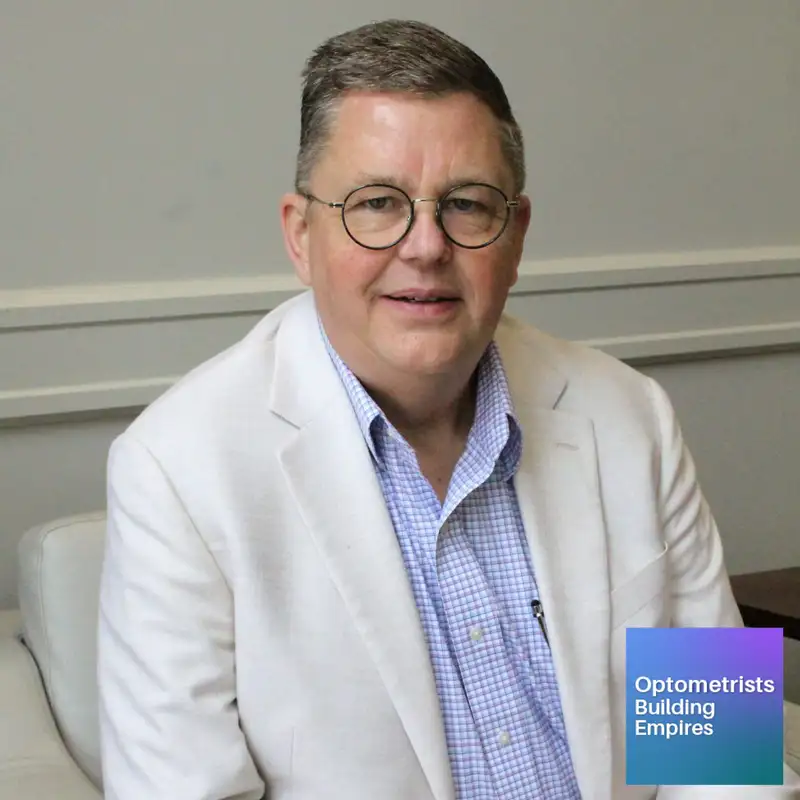
The Real Work Behind Scalable Growth - Rick Guinotte - Optometrists Building Empires - Episode # 085
OBE_Rick Guinotte
===
Rick Guinotte: [00:00:00] the decisions I make as a business owner doesn't just impact our team.
It impacts their households.
I know there are people that don't, just don't, don't agree with this, but I am all about pre-app appointing patients because it gives you peace of mind.
You have to ask, why do I feel the way I do? Is it because I'm scared of change? Or is it because I don't want to change?
This is Optometrist Building Empires, and I'm your host. Ankit Patel. Each week we'll explore the journey of practice ownership and leadership in optometry. Join us for insights and strategies from the top minds in our field. This show is sponsored by my business care team. My business care team helps your office increase revenues, reduce costs, and reduce staffing headaches.
Let's build your empire together.
Ankit Patel: Today's guest, I'm always excited to talk to him. He's a seasoned leader with more than three decades of experience driving practice growth, operational excellence, and team [00:01:00] development. beginning his career in 1989, he has held virtually every role in the optometric practice, including technician optician, receptionist, manager and territory director, overseeing 18 locations with 13 and a half million in revenue and more than 120 employees. 2015, he founded an independent optometric advising firm dedicated to helping private practices achieve sustainable growth and long-term success. also an A BO and COPE certified speaker who presents internationally inspiring optometric professionals to exceed the goals and thrive in a competitive marketplace. He's the CEO of Acqui os. Please welcome Rick Guinotte.
Rick Guinotte: I'm very, I'm, I'm excited to be here Ankit. I'm so thrilled to have this conversation with you today.
Ankit Patel: You know, you and I have been talking over the years and you, you are just, you have a brilliant mind. Honestly, it's, so I'm excited to have this and really just share some of your knowledge with, with the audience.
Rick Guinotte: I appreciate the compliment. I really do. Thank you. Thank [00:02:00] you. But I, I just do what I love. I and love what I do.
Ankit Patel: well, let's jump into it because you have actual experience to pull on as well as building your consulting practice and other people's
Rick Guinotte: Yeah
Ankit Patel: for you, what was the most important thing that helped you grow your empire?
Rick Guinotte: Overall the years having the experience that I had, You know, and, and, and learning and seeing opportunities in different phases of my career really opened my eyes. You know, I went from being a territory director over. You know, 18 locations, having a fun time with that to relocating to Omaha, Nebraska after living in the Twin Cities.
And when I came back here, Ankit, I took a job as a frame rep and You know, I, it really opened my eyes to how many private practices really didn't have an idea of how to manage something. Excuse what I'm gonna say here is easy as their frame inventory. I mean, there were offices that had. Over $30,000 worth of inventory in their, in their back stock, and it's just unnecessary.
So I started doing [00:03:00] advising on the side and I saw I could make a change in these private practices and helping them to see how they could work smarter more efficiently and they could grow their bottom line, not by really changing anything other. Their processes and it, it really, it, it got, it was a light bulb moment for me, and it, it snowballed from there.
And then I got into consulting and advising, and I just love seeing the growth these offices bring to their communities as well.
Ankit Patel: So what would you say is the, the theme there that, that helped you grow and help your businesses grow? Like what's the, what's the one thread that you think that might tie stuff together?
Rick Guinotte: helping people and seeing people grow and being able to help people unlock their practices to be able to blossom into something more than they ever thought before. And when I say offices, it's, it's everything. Not just what it brought the doctor, the owner of the practice, but even their staff members to see what a great career path this industry offers people.
[00:04:00] It, it's, it can be a career for people. You don't have to go to school for it. You can, of course, and get maybe a little bit ahead if you wanna get into management And so on, but you can learn it along the way and be able to really have a great balance of life while you're helping impact patients in such a way that they're, they, they truly.
Believe in you. I mean, it, people want to be able to see better. we have a great gift. Uh, uh, the Optometrists have, it's a, an amazing profession, I'll say sometimes undervalued, uh, by the general public 'cause they don't understand everything an optometrist can do. And I'd love being part of that to help them grow. They're, and send their message out to their communities to help people see exactly what they can do for 'em.
So it's just the passion for the industry, I guess is what I'm gonna say. Ankit
Ankit Patel: Yeah. And, and You know, your background. You've done, like One office, single location, maybe just a few
Rick Guinotte: Oh
Ankit Patel: 120 employees, 18
Rick Guinotte: Yeah.[00:05:00]
Yeah.
Ankit Patel: A lot of different stages of growth there to go from that to start up to there. Yeah. So tell me about some of the things that, um, from your experience, challenges that are faced
Rick Guinotte: Oh,
Ankit Patel: And maybe you can take us through like, the journey
Rick Guinotte: oh my God.
Ankit Patel: All the way to the 18 stores
Rick Guinotte: Oh,
Ankit Patel: people.
Rick Guinotte: that's a great question. You know, managing one or two offices was easy. It was when the third office was put under, uh, You know, under my belt that I went, oh my gosh. You know, it's, it's easy to be, and, You know, go back and forth between two locations and figure out how to fix things yourself.
But when you get to three, four, and five, you better learn time management skills very quickly, and it's through those experiences that have really helped me to be where I am today. Um, luckily I learned on somebody else's dime, if I said I was perfect day one, I, you could right now just watch my nose grow.
I'd be, call me Pinocchio. but, You know, going from, like I said, two offices, offices to three, four, and five was very challenging because [00:06:00] you had to understand. I can't just go over there and fix it. They have to fix it. I have to empower my staff. I have to expect my staff to be able to do this. I have to expect my leads to be able to follow through.
So. Teaching myself to learn to coach with a certain amount of cynicism was very difficult for me. Trust is earned. It's not given. And you, you, I really had to learn to push people, not in a bad way. Okay, I need this done by a specific date and how to follow through on things. Learning how to do that and going from, again, two offices that might, might have had 12 to 15 employees to now three where you're pushing 25 to 30 and then year to 35, 40.
It grows very quickly. I mean, the biggest office I ended up managing, uh, we had 25 employees in that one location, and it was an office that did right just under $4 million a year. It was, it was a big office, very fast-paced [00:07:00] office.
Ankit Patel: after I get past four or five locations, does it get easier
Rick Guinotte: it actually, in my opinion, it gets easier, but here was the key. I was, I made sure there was one manager. To this day I'll say she, she was. She was the future. She was gonna be my mini me. Um, Stephanie was, is her name, and she, I still keep in touch with Stephanie. She became an area manager for me. I could lean on her to, to, to do anything.
She knew what to do. She knew how to do it. She had the passion, she had the vision. I had coached her from being a receptionist and developed her up to being a manager to the naria manager and. So, and then I also had Jackie, so as I got to 18 offices, I was teaching others to do what I do. And I think that's also something when people are growing and developing in their leadership is it's okay to train people to replace you because when you do.
It makes your life easier [00:08:00] because if you have to do it all for 18 offices, your your head's gonna explode and you're not gonna enjoy life. You have to have a work life balance as well, especially when you have kids, which I did. And so Jackie, Stephanie, You know, they, they were key in an integral part to help me do things.
But they also, we also kept it fun. You know, when people look at statistics, when they look at their profit and loss statements. I don't look at it as, oh my gosh, how much money did we make? How much money did we, we, You know, did fell to the bottom line. It's all right. It's a game. Each, each section of that p and l is a game.
You know, cost of goods is one game within the cost of goods. You've got your frames, you've got your lenses, you've got your contact lenses, accessory items and such under your, on your staff. You know, that's pretty much is was what it is, but you have to manage your overtime. Oh my gosh. Why do we have overtime?
It's a game. How do I beat this that next month versus what we were last month? How do I be better next quarter for last month? You make it a game, so it's not, you're not thinking dollars all the time. [00:09:00] You just look at scores and points. Statistics are like your report card that you see from your kids.
You know, how are we doing? How are we educating patients? It's not about selling, it's about educating and giving options. So making it fun, making games with it, and really empowering people and following through our key areas, in my opinion, to a good leader. Being able to. Grow and be successful and still keep their wits about them so they don't pull their hair out.
Ankit Patel: And so you, you now work with a lot of different clients. Not all
Rick Guinotte: Oh yeah.
Ankit Patel: Be 2, 3, 4, 5 locations.
Rick Guinotte: No.
Ankit Patel: Of 'em are probably just starting off one location, right? Maybe they're just, uh, uh, just getting started. What, what, what kind of, uh, help me walk through that journey and what you see are common things that are unexpected from the doctor's perspective,,
Rick Guinotte: i'm gonna give you a scenario of a doctor I've worked with for many, many years.
He'll know who I'm referring to, and he's gonna gimme a hard time when he listens to this, but that's okay. So he, he and I were, we started working together and he [00:10:00] sends me over his stats and all of his performance indicators and all that stuff.
We start reviewing, I start reviewing it on our f on our phone call. I apparently made a comment to him. I said, this is the flattest office I've ever seen in my life. And he goes, what do you mean? And I went on to explain, You know, over the past three years, you have only done this much money. It was under $450,000.
It was between 400, 450,000 over three years. Hardly any growth whatsoever. And he had opened the office brand new. Did it on his own. He's a great guy, but he did, he didn't have the guidance to, to, or, or support to, to show him what to do. So when I, as I started working with him, I went and did an onsite visit, and one of the things he did right away when I, when we, I got to the office, we go to an into his office and he sits down, he goes, can you read that?
That note that's in the frame there. I said, no, I can't. My eyes aren't that good. So he hands it to me and it says, this is the flattest office I've ever, I've ever seen, and he has quotes around it with my name on it. [00:11:00] He goes, fix it. Just points at me and says, fix it. I said, all right, let's do this. So during the onsite visit, You know, I saw some key indicators, uh, opportunities in his office.
End up walking away telling him he needs to buy another lane of equipment. He needs to work more efficiently. He's gotta hire another employee. They're running too tight for what they're doing. He only had three employees. Well, if you look back, and this is 14 years ago, so the this, this number I'm gonna share right now is different.
Now, back then it was one employee for every $150,000 that an office would do well with inflation, everything, it's now closer to 200,000. So he's doing 450,000. He only has three employees. He's maxed out his staff. He's maxed outta his staff. They can't do anything. Hey doctor, you need to add another exam lane.
You need to hire another staff member. And we're probably gonna add another employee after three months. 'cause once you get that other chair going and you get that other exam room going, you're gonna need another employee. 'cause you're gonna have your optical backed up. So you're need another optician in here.
And [00:12:00] after that happens, you're gonna be able to do this, this, and this. Well, lo and behold, that office jumped from being under $500,000 that year to over 700,000 the next month, next year. Then it grew and it grew, and then it was a few years after that. This is just fun. So he, he, he c he we're talking on one of our calls and he says, Hey Rick, there's a plot of land just down a quarter mile down the street.
They're putting in a medical complex. I could own my own condo, blah, blah, blah, blah. I think it'd be really good. What do you think? I'm like, I'm all for people owning their own property. Why? Why pay a landlord for something that you could do yourself, or you can hire out to, You know, repairs, things like that.
So why not? But here's what I want you to do. I want you to overbuild. You're, you're building. Instead of doing only 4,000 square feet, let's build it for 5,500 to 6,000 square feet. He says, why is that? I, well, let's get another tenant in there. Have them pay the rent. Their rent goes to pay your mortgage.
Now you're living, you're, you're working here for free and your [00:13:00] holding company gets paid. So we structured all that worked with him. His office is now on track to do over $3 million these years. Just a fun, just a fun scenario of a doctor that grew and he listened. I do think one of the biggest hurdles that people run into is when to hire a new employee.
And I understand that as a business owner. As a business owner, when I hire a new employee in, I don't look at our team of just how many employees we actually have on my payroll. I count their significant others, their spouses, their children, And so on, because the decisions I make as a business owner doesn't just impact our team.
It impacts their households. Okay, so I understand why people are nervous to hire more employees because you, you never want to have to lay off people, and I've always been able to say I'm very proud of the fact that over all the years of managing 18 offices. I never once had to lay people off. I always found a way [00:14:00] during tight times to make the payroll work and make sure the business could grow.
There's always a way you have to think outside the box. If you're inside the box, you can't see the label. You've got to see from outside in to see where opportunities are.
Ankit Patel: Gotcha. Yeah, I, I think that's a great insight for, for, and a great example. Uh, and, and, You know, what are some of, let's, let's kind of lean on some of your experiences talking
Rick Guinotte: Okay
Ankit Patel: of different practices.
Rick Guinotte: Yeah.
Ankit Patel: What do you see as the common trait with doctors who grow their practices? Let's say they have one really large location, or they get multiple locations.
What are some common things you see between them all?
Rick Guinotte: Vulnerability.
They're vulnerable. Vulnerable, and, with that comes willing to listen.
I mean by vulnerability is they, they, recognize. That they don't know everything, You know, so they look outside for guidance. [00:15:00] they look for help to guide, to look over what their office can do and where what game plan can be put in place to be able to grow it.
They also have to be willing to change, and that's also where vulnerability comes into play and a good listener. Understanding the whys. what, can I do different to make my practice better? How can I make it better? How do I market myself differently? How do I attract more patients in here?
How can I be part of the community? Because if I'm part of the community I'm gonna bring more patients in. So those are just a few things that I always look at with, practices that I work with and with owners that I work with to be able to help them look beyond today. And teach them to look out and not just look at, oh, we had a busy day today.
We must be good. But what does tomorrow bring? What's the day after look like? What does two years look like? What does three years, what does five years look like? You guys, I mean, look how [00:16:00] fast 2025 went and we're into 2026 and we're already saying, wow, look how fast things are moving here. It is amazing how quickly time goes.
You just can't let it get away. You have to, you have to understand how to manage that time. So be vulnerable and ask for help, whether it's through colleagues, whether it's through outside companies, whomever, get advice. Don't, don't ever think You know it all. I don't know it all, and I've been in this forever.
There's always something new coming out. Always something new to challenge your, your, your organizations.
Ankit Patel: So let's talk about the emotions that this is something that doesn't get talked about enough. And I can tell you from personal experience and other people's experience that yes, yes, I can learn, I can do these things, but I am, You know, there's always that mentality of like, oh, that's hard to do. There's always some sort of, there's usually some sort of emotional block like, oh yes, I know I should do X, Y, z, I know I should hire someone. Emotionally. That's rough. That's hard, right? It's scary. It's like, well, that's a lot of money going out for hiring someone or whether I need to make a decision on, okay, this person's, I need to, I need to figure out a different location for them. Different thing. So [00:17:00] talk about some of the emotions that people feel during this process and when you're, when they're trying to grow.
Like where are people gonna experience that from your, what you see?
Rick Guinotte: Oh, I think, I think there's a certain amount of doubt or question that people are gonna have, and that's normal. But you can't stop there. You have to ask yourself. You have to ask, why do I feel the way I do? Is it because I'm scared of change? Or is it because I don't want to change? And if you don't want to change, that's, you should be a little nervous about that because change is important in any industry.
Just ask Kmart, Sears, and others. Okay? So if you don't change or evolve, you're gonna be left behind or you're gonna end up having to make tough decisions. If it was easy, everybody would do it. So it when when you hit a point where you can't get the answers to your questions and you're or, or you're scared to do it, that's when it's definitely time to reach out to somebody else, again, a colleague, [00:18:00] whoever,
The one thing I've noticed over all my years when, when somebody gets to that point. Is, I know it's time then to show some projections and be able to show them if they make this change, here's what it'll do for you. And I'm a Midwest person. I'm very conservative. I'm not that person that's gonna say, we'll take an office that does $700,000 and it'll do $2 million next year.
That doesn't happen unless significant. All, uh, everything aligns like a doctor who worked over there comes in here and that office completely closed and there's nowhere for the patients to go. Yes, that has happened and it does happen, but it's the exception. Okay, so I will help people look at the, and see if we do do projections for the next 12 to 18 months.
Here's where your office is today. If you do this, this, and this, imagine that this is what you're gonna get to. One of the simplest ones, and the decisions I make as a business [00:19:00] owner doesn't just impact our team.
It impacts their households.
I know there are people that don't, just don't, don't agree with this, but I am all about pre-app appointing patients because it gives you peace of mind.
You have to ask, why do I feel the way I do? Is it because I'm scared of change? Or is it because I don't want to change? Why do you wanna hope that your appointment book is gonna get filled for next week?
You already have patients that love you and want to come back to you. pre-AP, appoint those patients 53 weeks out. So that you can see next year, wow, I'm already 50% booked for the next six weeks. And now if we get this many new patients calling in, in addition to that, plus those patients that refer other people to us, all of a sudden we're booking better.
But I get pushed back on pre-AP appointing at times, but that's also why doctors. Cannibalize their business. They didn't change because they [00:20:00] didn't pre-AP appoint. They didn't have the confidence to grow, hi, hire more patients in or hire an associate in because they could, they, they couldn't grow. And they end up working for four to five days a week, all their years, all their, their entire career with very little planning for exit strategy, and then they're caught between a rock and a hard place.
If they didn't plan that exit strategy seven to five years in advance.
Ankit Patel: Interesting. good. That's actually really good insight. I, I appreciate you sharing that. Um, and let, let's, um, let's look to the future a little bit more. Uh, what are you most excited about for the industry, uh, your, your practice? Uh, just in general, like, there's a lot of things I think out there, so I'll let you take, take that where you want.
Rick Guinotte: I'll, I'll start with the industry. Um, it, it is amazing all the changes that this industry has gone through. You know, when I started back in the 19 hundreds, You know, the, the thoughts of. Disposable contacts just came into the market in the, [00:21:00] in the mid to late nineties, and that was, You know, where this lens for two weeks.
It wasn't these daily disposable disposables. We didn't plan for having contact lens trial rooms to, to inventory all this stuff. Now yet. You fast forward to today and we've got dry eye spas being developed, You know, rooms for that specific specialty. We've got vision therapy practices. Opening more frequently.
We have doctors doing NeuroVisual medicine. We've got people doing myopia management. Uh, again, dry eye spas as a whole, and ipls all this moving forward. So this, this industry is never, is always changing. It's never stagnant yet we always have something that comes out once in a while that scares everybody that, oh, this is gonna be the end all be all for, for, for optometry.
And all it end up doing is, is enhancing the business. AKA LASIK surgery. You know, look at that today. What? What? It helped the business there. [00:22:00] Meaning people are in progressive lenses at a younger age, um, because of it. So I'm excited for, to be able to continue to help these Optometrists really embrace the medical model in their practices as well.
There's more and more responsibility and, um. Being put on the optometrist over what? The ophthalmology, because there's such a shortage of ophthalmologists, uh, in the, in the end, in, in the various communities. So more Optometrists are taking care of more and more, um, foreign body removals, eye health, eva, uh, whole, I should say healthcare.
Um, more medical diagnosis type things. Um, so the future is great. I don't see any concerns there. As far as some things with, with us at, at Aqui os, uh, we're very excited not only to continue to offer our advising services that we've been so successful over the years, but we've, uh, we, we've just launched and introduced our new Advantage [00:23:00] program.
Uh, we've recognized that there are doctors out there that are. In need of leadership for their practices, whether regardless what phase of their practice they're in, we have years of experience in our leadership experience on our team. Over 230 years of management experience is on the Aqui OS team, and we've now hired people in to be called, what's called what we're calling strategic partners who are going to be able to have daily phone calls with offices, do regular onsite visits.
Really analyze the profit loss statements. Basically what I did as a territory director. We are gonna have a strategic partner being able to do that with private practices to enhance their business, get the monkey off the doctor's back, if you would, so they can focus on the clinical skills that they have honed and mastered to be able to take great care of their patients so we can take care of the human resource, the business side of things, along with their team, and help show [00:24:00] their team members what a great career this can be for them.
Because again, it truly is an amazing industry.
Ankit Patel: Yeah. And, and with that, I'm curious, how is that different than normal consulting? Like, like give, gimme an example,
Rick Guinotte: Yeah.
Ankit Patel: If you
Rick Guinotte: Okay. Well, uh, for example, at Aquis Advisors, what we do with our, with our clients, we, we work not only with the doctors, but we work with their managers on a regular basis. And you have access to all of our webinars, all of our learning tools that we have. You're welcome to email us between our phone calls if an emergency comes up.
Yeah. We'll jump on a call with you. Okay. we look at financials, we look at stats. We do all of that with advising. Okay, so here's the benefit. With advantage. Not only will you have your strategic partner, you're also gonna keep an advisor. So you're gonna get the best of both worlds, meaning you're gonna have the advisor who's at a 30,000 foot view of the practice being able to look down and say, Hey, here's our opportunities.
Here's what we need. Here's what you should implement [00:25:00] into your practice. Well now instead of the doctor who's seeing patients eight hours a day trying to implement something in the office, we now have the strategic partner who's gonna be a pseudo manager with the practice having regular phone calls along obviously with the advisor, they're on the same team.
And then you've got this person now doing. The implementation with whether there's an office manager in the office or working with leads in the office, they're gonna help them really to put it in there. Plus there's gonna be regular onsite visits with that strategic partner. Our goal is every three to six weeks that they're in there at least one day to be able to spend, You know, a few hours in there, have their eyes on it, see what's going, what's doing well, where do we do this?
Just like a, a field manager would in a commercial setting come in. Here's our action plan. Make it happen. Now, the advising group, along with the strategic partner, is gonna work with that office to implement those actions to make the practice better for the patients, better for their team members, [00:26:00] better for the doctor, and grow the business and add value to it.
So when the doctor's ready to sell that practice. Ultimately we're, we're gonna want to help them have that exit strategy in place if they're within that eight timeframe, and help them grow the business so it's higher value for them, and then help their associate buy it, buy in, or buy out the practice or find somebody who would be interested in buying the practice with them.
Ankit Patel: if I, if I'm making an analogy and correct me if I'm wrong, it's almost like, okay, well, You know, if I, if I just wanna stay healthy, maybe I had to go to my annual doctor visit. That's normal, right? Like that's consulting. But what this is saying is like you have that. In addition to that, you also have concierge medicine, and you have a personal trainer that holds you accountable every day, and you have a nutrition coach that's helping you.
Rick Guinotte: Yeah. That, that you, you, you summed it up very, very well. I mean, we are trying to take the monkey off the back of the doctors without them having to sell the practice off to private equity.
Where they promise them one thing, but what reality really comes down to is they can't deliver, they don't have the boots on the ground. we know there's gonna be a demand for what we've put together. [00:27:00] We put this together over a good period a a period of over a year. Okay. We spend a lot of time really honing in on can we deliver this?
Because if we can't perform at this, we're gonna trip and fall. But we are so confident going into this with the team that we've assembled to make advantage be everything that it's going to be, that we know will exceed doctors' expectations. We know we're gonna grow their business and be able to have them
Ankit Patel: Awesome.
Rick Guinotte: In a much better place tomorrow than they are today.
Ankit Patel: Yeah, I know personally like, look, I know how to lift weights. I know how to eat properly, but it's a lot easier when I have someone correcting my form and telling me exactly what to do. I still have to lift the weights, but
Rick Guinotte: Yeah.
Ankit Patel: When someone is there helping me walk you through there or different saying like, Hey, I gotta be accountable to you when I'm measuring my, my food, and things
Rick Guinotte: Right,
Ankit Patel: yeah,
Rick Guinotte: right.
Ankit Patel: Appreciate that. Yeah. So, so I wanna, I want to get, uh, insight about, uh, you personally and
Rick Guinotte: Yeah.
Ankit Patel: Uh, You know, shift gears a little bit.
Rick Guinotte: Yeah.
Ankit Patel: Give me a story that's formative for you that, that, that made you who you are, that made Rick who he is. It could have been something when you were [00:28:00] much younger.
It could have been more recent,
but
Rick Guinotte: Oh,
Ankit Patel: like, yeah, this, this impacted me and changed me
Rick Guinotte: I I see you're one of these people that try to make people cry when they do the do do this with you. I appreciate this Ankit. Okay. Um quite honestly, the re what, what made me who I am today was back in my childhood, um, my, my mother, father, um, great, great people. Um, I was one of five children. I had four.
I have four sisters. I was the only boy. Um, unfortunately my father back in 1979, when I was only 10 years young, uh, he had a massive heart attack and passed away at the age of 42. And my mother, single mom never remarried, never even dated again at the age of 38. Um, as I became as. I don't know how she did it.
Let me just say it that way. Um, but we had a lot of responsibilities put on us at a very young age, and being the only boy I had to do the [00:29:00] boy jobs as I do air quotes around boy jobs, meaning the trash has to go down on trash day. The yard has to be mowed. Yes. At the age of 10, I was responsible for mowing and trimming our yard.
I could barely see. I have pic we have pictures anyway, uh, of me pushing the mower anyway, so there are a lot of responsibilities put on us, which gave us all of us great work ethics. Um, you asked me to do something, I get it done. I, I, I pe somebody tells me I can't do. I say, hold on a second, let me show you.
Um, I've o overcame a lot of things. In one of those WA was also learning how to communicate with, with women. You laugh at that if you want, but in all fairness, being with five women, being the only male in a household. You learned a at a young age when my older sisters, I had three sisters that were older, one sister younger, when a boy would come for to pick up [00:30:00] one of them for a date.
I knew you didn't honk your horn. When you pull in the driveway, you go up to the door. 'cause mom didn't let them go out the door until they came to the door to greet her and meet her. So I learned a lot. I learned a lot of, You know, how to treat people, how to communicate with that. Um, um, again, the work ethic is big.
And it was very interesting. It was about maybe 10 years before my mother passed, so it was probably about 15 years ago. We were at Thanksgiving. And during that and, and we were going around the table and she started crying and all of a sudden she goes, I owe you kids an apology. We're like, for what? And she goes.
I put way too much on you guys at a young age. I mean, we, again, we had responsibilities when you got home from school, you, it might be your day to make dinner. And it wasn't just dinner, it was a roast. It was potatoes. It was it, yeah. She'd have everything in the refrigerator, but she had the instructions on the, on the.
Counter for us to do this, or if it wasn't your day to do dinner, it was your day to grow, to [00:31:00] do the dusting, or you had to, you had to, uh, vacuum the house out, You know, you had to do, I mean, there was always something we had to do. Okay. But she starts apologizing at Thanksgiving to each and every one of us for all the work she had us do.
And we looked at her and we kind of laughed, You know, and we said. Mom, why are you upset with this? She goes, I just put too much on you guys at such a young age. It wasn't fair. And I looked at her, I said, mom, you've got a sis, one of your daughters over here. Sandy took a grade school to be a blue ribbon school.
You know, she's won multiple awards as the principal. She now has her PhD. She's now with the Nebraska's Department of Education. You have Linda over here who's got her master's degree in special education. You have me who started my own business now and doing very well because of this. My younger sister, Debbie, does very well for herself as well.
She's a higher up in in in an organization as well. I said the work ethic you instilled in all of us. It made us who we are today. [00:32:00] There's no reason to apologize. All my sisters looked at me and goes, I've never seen you be so, so, so stern with mom before. I'm like, well, there's no reason for her to be crying about this.
She should be celebrating it because we all turned out well. Did we grow up faster than we probably should have? Yes, we did. It made me what I am today and I'm very thankful for the experience I, the experiences that I went through to apply them to my everyday life and be able to share that with my family and my business family as well.
Ankit Patel: I love that. Thank you for sharing that.
Rick, thank you for,
Rick Guinotte: Yeah.
Ankit Patel: Some, some great information. I think, uh, You know, we'll give people a chance to reach out to you. Uh, if they have more, they want to
Rick Guinotte: Yeah.
Ankit Patel: Where can people find you if they wanna reach out to you.
Rick Guinotte: Easiest way to find us is@aquios.com. That's our website. It's A-C-Q-U-I-O s.com. Um, you can also find, you can also email us at info@aquios.com. It's info I nfo at aq u io. Dot [00:33:00] com and we'll be happy to, You know, schedule a time to speak with you and share what we can do and help you with your practice and hopefully help you find a better balance of, of life, both professionally and, and, uh, and personally for yourselves and your family.
So Ankit, thank you so much for having me here today.
Ankit Patel: Yeah. And thank you, uh, Rick for, for joining us. Um, and I want, I wanna share a takeaway that I, I usually have, uh, one, one of my takeaways from today was uh, learning and keeping, uh, always being open and receptive and vulnerable. Uh, that's something that if you want to grow. That's the one of the main characteristics that you've seen time and time again, so I appreciate
Rick Guinotte: Awesome, happy to share it with you. Glad glad you had that takeaway. It's a great one to learn by.
Yeah. And thank you audience. If you learned something or laughed, please share the podcast with, uh, with a friend and make sure you subscribe so you don't miss an episode. And if you see the meeting link at the show notes, please if you make book a meeting, I'll send you [00:34:00] actually a free copy of my new book, optometry Redefined. And thank you again, Rick. This has been another exciting episode of Optometrists Building Empires. We'll see you next time.
That's a wrap on another episode of Optometrists Building Empires. Thanks for joining. For show notes and more Visit Building Empires live. This show is proudly sponsored by my business care team. My business care team was born out of staffing challenges. My wife and I faced together managing multiple optometry locations.
We refined our approach at classic vision care and now offer our expertise dollars. If you're experiencing challenges with staffing and you'd like to set up a discovery call, we'd be happy to help you and connect you with the right resources. We'll see you next time.
Creators and Guests