Scaling a Family Practice - Hunter & Taylor Edwards - Optometrists Building Empires - # 082
OBE_Hunter & Taylor Edwards
===
Ankit Patel: [00:00:00] hmm.
Taylor Edwards: Um,
he was the only optometrist practicing in his county.
it's not just, You know, break down a p and l sheet. It's how to, it's how to make somebody truly feel like they were taken care of.
Hunter Edwards: We have our knockout drag outs and. And by the end of it we're joking. we grew up around it, um, You know, uh, the, the roller chairs down the halls, racing them when we were young.
Taylor Edwards: It's just the, the, absolute pleasure it is to work with somebody who has a brain that's wired different than you, um, and how much you can appreciate a, that, that different way of looking at it.
'cause Alon of the times it's better.
This is Optometrist Building Empires, and I'm your host. I'm Kit Patel. Each week we'll explore the journey of practice ownership and leadership in optometry. Join us for insights and strategies from the top minds in our field. This show is sponsored by my business care team. My business care team helps your office increase revenues, reduce costs, and reduce staffing headaches.[00:01:00]
Let's build your empire together.
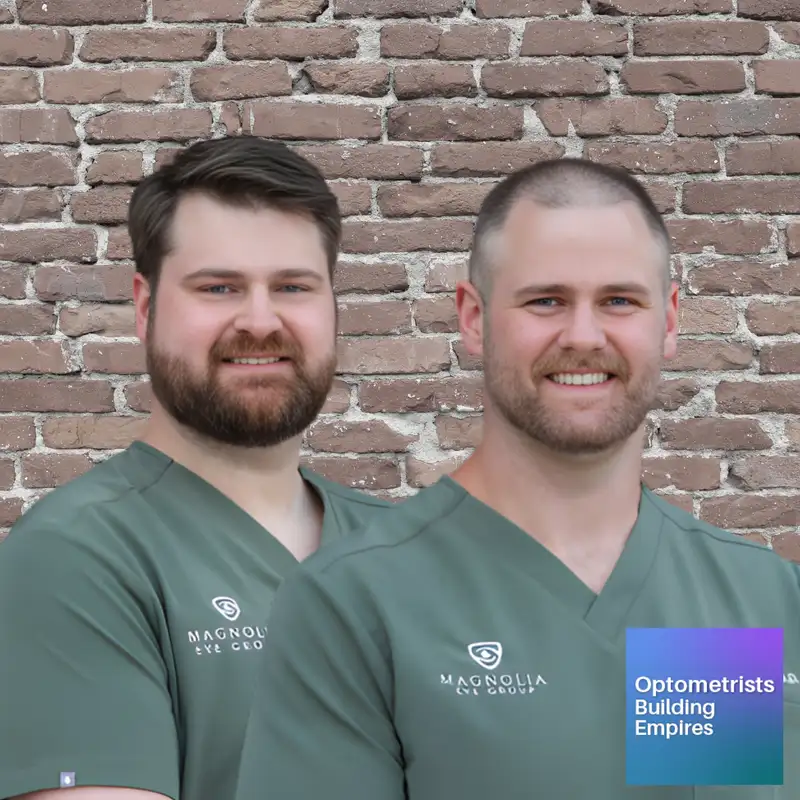
Ankit Patel: Today's guests are impressive duo that I'm excited to introduce you all to. They're both licensed Optometrists from Water Valley, Mississippi and combine a shared passion for eyecare with strong ties to their community. Their practice has been a pillar for the community for two generations and is dedicated to providing comprehensive support to preserve your eyes and vision.
With five locations in Mississippi, the comprehensive eye care services combine state-of-the-art equipment with compassionate care tailored to each patient's unique needs. They're Optometrists and owners of Magnolia Eye Group. Please welcome Doctors Hunter and Taylor Edwards. Doctors welcome.
Hunter Edwards: Thanks for having us.
Ankit Patel: Yeah, yeah, you guys, uh, this, this is a bit of a treat. I'm excited to talk to you all 'cause you guys have a really unique story and really impressive business. Uh, so with that, what was the most important thing that helped you grow your empire?
Hunter Edwards: Um, I'd have to say it was [00:02:00] having a father that was an optometrist in the business. know, we grew up around it, um, You know, uh, the, the roller chairs down the halls, racing them when we were young. So we were always in that environment. Um, and maybe not necessarily that's what we wanted to do, but being around that, um. around him. And, uh, then we got out, You know, we, we had saw firsthand how to run a, an optometry practice. And, but there was a sense of, I guess, ownership in that, of, Hey, we want to learn how to do this ourselves and not just sit by the wayside and, and let it go on. So Dan was. Really integral in that of kind of showing us, You know, here's kind of the business side and, and that's important, but ultimately you're taking care of people [00:03:00] and if you take care of them, they'll take care of you.
And so that's probably been the most we've learned and
Ankit Patel: Yeah.
Hunter Edwards: Some difficult lessons too of, of, You know, unhappy patients and,
Ankit Patel: Yeah.
Hunter Edwards: Uh. hey, You know, you need to address that with that patient. And, You know, don't, don't let them leave angry. You're gonna call them. And, And so it's a, You know, it was really good and you sit back and you're like, man, I'm glad he, we had somebody there to kind of help us through those types of situations too.
Ankit Patel: Yeah, it's hard to do it alone. Uh, and, and Taylor, I know you guys, um, I'll let you guys get into your story a little bit, but what about you? What, what do you think was the most important thing that helped you grow your empire?
Taylor Edwards: yeah, I mean, I think it is the, you can't just, you can't understate the guidance that dad provided. Um, uh, the interest was always there. Um, growing up in that environment. Growing up in that culture. Um, I think the biggest thing to, to compound kind on what Hunter was [00:04:00] saying was. The, the way that he had built that culture and that clinic is what we try to instill into every community and every clinic that we have. Um, the, the feel, the family environment, the, you walk through the front door and You know that everybody there kind of cares about you. Um, so I think that to, how to develop a culture of, um, of caring, um. Loving people that, uh, that were diligent in their follow-ups. Um, um. to criticism, um, and just really, really have a heart for caring for patients.
I think that that was, um, that's been the biggest thing. You know, it's not just, You know, break down a p and l sheet. It's how to, it's how to make somebody truly feel like they were taken care of. Um, so
Ankit Patel: Yeah.
Taylor Edwards: That was, uh, that's been the biggest thing. We just can't, we just, we know that. We know that everything that we've got, um, so far and the progress that we've gotten is that's the driving factor.
Ankit Patel: [00:05:00] I like that. And, and I'm curious, uh, You know, when, when you took it over, uh, so help us understand your situation a little bit. Is your dad still involved? What does the situation look like? What was it like when he first took over versus the five Okay. Locations. Now kind of paint a picture for us of how you guys have taken your father's legacy and grown it.
Hunter Edwards: Um, so I was first out, so I graduated in 21, at, at that point we had. Dad, You know, one and a half offices. And so I was working with dad most days kind of learning, and it, it was rough, You know, it was, You know, the, the line between son and and colleague that I think that was tough for him and tough for me too. And, but after a couple months of just getting, I think that worked out. I mean, it's been smooth sailing since like, like it's, it's so much fun. yeah.
Ankit Patel: Yeah. And, and Taylor, what about you? You came along a couple years later, right? Uh, so [00:06:00] yeah. Tell us about that, like how that was for you as an experience.
Taylor Edwards: So I always like to say Hunter. Hunter kind of worked out the kinks by the time I'd gotten there.
Ankit Patel: I.
Taylor Edwards: Um, and I think that, uh, I, I graduated in 22, And so we were still at one and a half. Dad is still very involved. He's five days a week, as are we. Um, we're, we're pretty, we're spread pretty thin right now, but that's okay.
Um. And so he's, he's, he's been very involved in that and it's just been pretty impressive. I mean, he, he switched from, he was on paper charts. Um, he switched to an EHR knowing that we were both in optometry school. So he tried to lay the foundation. And then of course, once we get outta school, and You know how technology goes, now we need a new EHR.
So he's been really like. Malleable. I mean, not without some coaxing and coaching, um, into some changes, but, um, he's, he's been very, very adaptive and very, I gonna say, uh, flexible for sure, um, on some of the things. [00:07:00] 'cause it's, it's, you're, you're trying to bring in the latest and greatest, but the latest and greatest is always changing.
And so it's, it's always a little bit of trying to be conservative, trying to keep what makes it great, great. And then trying to figure out what is actually. how do we triage, uh, some of the things and some of the new things we want to implement?
Ankit Patel: Yeah.
Taylor Edwards: ' cause it was kind of mouth on a fire hose there for a couple years.
Ankit Patel: Yeah, let, let's build on it a little bit 'cause You know, you're one and a half and you guys took it to five now. Uh, so let's talk a little bit about w why, why grow it, right? Uh, and if your dad laid a great foundation for you wall, but you guys have taken it to another level. So let's focus on that side of the journey for a little bit.
Taylor Edwards: Yeah.
Ankit Patel: Why grow it? What made you drive? What were the decisions that fed into it? Um, and, and I'll let Hunter, if you wanna start and Taylor pitch in, whatever. I'm kind of curious to see why the business side of that, as well as the mental and emotional side of that growth.
Hunter Edwards: Um, well, I think we had to, uh, we're not small [00:08:00] dudes and three of us in a one office gets cramped. Um, but, but we're, we're in, You know. Rural communities. Um, so we're, You know, that that main office was in our hometown and just about every patient that's coming in, You know, is not calling you Dr. Hunter or Dr.
Taylor. They're just calling you Hunter and Taylor. 'cause that's all that, that's what all they've ever called you. And it doesn't bother you. But it is just like you've known, folks that's changed your diaper. So, You know, then from going to, so we knew we had to grow. Um, dad had a, a, a partner at the second location that I think Dad, um, started it maybe about 25 years ago. Brought him in. They were partners and we needed space. Um, so we purchased that office, um, and, and grew to two. that was, so I, I. Well, I'll take that back a little bit. I, I [00:09:00] was working there part of the week, so when, by the time Taylor graduated, he was at pretty much the hometown office the, throughout the week.
And we had a couple things in, in play, um, of, we knew we were gonna expand. We knew we needed at least off three offices, and I think. We had an opportunity fall in our lap of an office that was, um, about to shut its doors. we were like, Hey, we have the doctor days. Um, it was a doctor that, um, uh, best pretty close with dad, You know, colleague. so we were like, yeah, we'll, we'll see what we can do with it. And so we had Dr. Days, so we kind of sent Taylor over there. that became our third office and the. The, I guess what our, what is now our fifth office, we had actually signed all the documents to take that over before this one fell into [00:10:00] our lap.
So it's been like a three year process. And that was an old family, Fran, that's like, Hey, I wanna,
Ankit Patel: Yeah.
Hunter Edwards: I got a couple years left. You know, Taylor will go down and work with him a couple days. And so it was kind of slow playing. We knew that one was coming and we just kind of picked up one extra on the way. Um. But yeah, we, we need, we needed room.
Ankit Patel: Yeah, I, You know, it's interesting 'cause I'm hearing something that's pretty, pretty interesting 'cause uh, you guys may not hear as much of where you are, but especially in the cities and other locations and online, you hear about PE consolidation, our industry, you guys are going the exact opposite, right?
You guys are in rural areas, serving the community, have been there for the long term, like generations at this point and people are coming to you to be like, You know what, we entrust our community to you all. 'cause you've been here, you've lived it. It's almost like another model that you could operate at, right?
In these rural communities, which, which I don't think we hear about too much, which is interesting. Um, as you guys are talking, that's kind of what I'm hearing. Is that how you guys kind of see it too?
Taylor Edwards: I think the, [00:11:00] um, uh, the, the, the driving factor of everything and the, even from dad starting that practice that he ended up having a
Ankit Patel: I,
Taylor Edwards: was there was not a optometrist in, in that county.
Ankit Patel: Hmm.
Taylor Edwards: Um, he was the only optometrist practicing in his county. Um, so there's just, there was Alon of need and there is Alon of need in Mississippi.
And so when you hear of a clinic shutting its doors or there's an optometrist that is, um. That is about to retire, um, and need somebody to kind of become a steward over the patients that he's been taking care of for years. That's, that was basically how we grew to that four. Now, the fifth one, we, we saw the, there was an area of growth, um, and the growth of optometry presence was not, You know, matching that growth.
And so we knew that there would be a need there. And so that was, uh, that was our cold start, um, that we opened last year.
Ankit Patel: Yep.
Taylor Edwards: Um, You know, it's, it's kind of been like, we've gotta just be like, okay, is this, is this a good situation? Do we think we can afford this? Can we [00:12:00] manage it? But most importantly, is there a need for us to fill?
Um, You know, it's, we've been, we've been very, um. We, we've been very set on not being necessarily predatory.
Ankit Patel: Yeah.
Taylor Edwards: Too many opportunities for other people to get, have good access to care, um, for us to be like jumping into any big markets and trying to go and compete against other Optometrists that are, um, already taking care of patients right now.
So that, that was how we all started off in the heart of how we started growing things was where's the, where's there a need, where's there people that need that access and, and try to fulfill that?
Ankit Patel: Yeah, I like that. Uh, and I'm curious, uh, You know, you, you guys are a family business. You guys favor fight much about stuff, right? Like, how does that work? I I, You know, I think people want to understand like, you got your dad, brothers, that's gotta be interesting, right? Dinnertime conversations, like talk, talk to me about that relationship, that dynamic.
How does, how does that work for you all? You, you touched on a little bit about, You know, at the beginning how Hunter kind of laid the groundwork, but how does it work now? How'd you guys come to a, [00:13:00] a path.
Taylor Edwards: I think we, I think we have a doctor, well, we have a dad that, You know, is not arrogant by any means. I mean, he knows that, he knows that he is limited on his time in, in practicing optometry and he's. adamant that we're left with, um, left in a good situation and the patients are left in good hands. Um, And so he's been, very, like I said, just kind of, You know, good at passing the
Hunter Edwards: Which.
Taylor Edwards: And, and good at just saying, I don't necessarily agree with it. Um, but y'all have got my 2 cents and then y'all go take and run with it. Um, And so, um. Uh, there's been, there's been, You know, there's Alon of times where we always say the dinner table is also still kind of the boardroom. It's, You know, uh, our wives know that when we sit down and it'll, you can count to about 10 Mississippi, and we're talking about eyes.
So it's, it's all the time. So, um, I think it's gone good. Even at the times where we're kind of. Chomping at the bit and upset at each other and whatever. It still always comes from a place of love. You know, no one's trying to get one over on you.
Ankit Patel: Yeah.[00:14:00]
Taylor Edwards: It's not, um, it's, there's, there's, it's only trust, uh, trust and love.
And so it's the base and root of And so it's easy to have hard conversations with that when You know that there's no, it's not a greed thing, it's not a, it's not anybody trying to, uh, outdo the other one. It's, um, it's all a similar goal. So it's been, we're, we are very, very blessed in that fact.
Ankit Patel: Uh, hunter, do you see it the same way or do you see it differently? Just curious.
Hunter Edwards: No, no. Yeah, I mean we, we have our knockout drag outs and. And by the end of it we're joking. And You know, just kind of, You know, I'll, you'll kind of see our office manager like, oh no, they're getting, he, and I would say our last one, it doesn't happen often, but You know, we had one with the, the HR change.
Um, and then after the fact that was like, I'm so glad y'all made me. Changeover. Um, y'all, You know, it's like, hey, if you believe in it, You know, push back on me. So, that's, and we, we, we do that too. I mean, we play both, we try to play both sides of every [00:15:00] argument. And so I think we're all like that. So we both can present a counterpoint and, You know, understand it's, tearing it down essentially, you're, you're building up your side of it.
Ankit Patel: I like that. Good. I think that's good for any kind of communication, whether you're working with family or not. So I work with my wife, so yeah, it's been similar challenges at times when we were working in the offices. So, um, so, so curious, uh, what were some things you guys ran into that you haven't talked about that was unexpected?
You're like, oh, I didn't expect this at all as we were growing.
Taylor Edwards: I guess unexpected was the, the rate in which it happened. Um, so like I said, I graduated in 22. When I graduated, we were still at one and a half. end of 22, we signed, a purchase agreement on one. Um, uh, that was a three year thing. And then we've got, we had, we bought out the partner, um, [00:16:00] and then there was, um. The, there was that one that kind of fell into our laps that we were, And so the pay structures on all those made it easy for us to do all that at once financially. Um, And so we could, we could. Add that on. And so it just kind of really opened up for us. So the struggle was just like, Hey, we are, we're about to start hiring people that are not techs and opticians in front desk. You know, this was, this used to be a three role thing, but now we have to have people that admin staff. You know, you have to build out those things. And how do You know who to promote and how do You know who to, who's necessary? And your, your, job descriptions really start kind of getting murky on when you're like, we need to. We need more people and we don't really know what we're doing and what to outsource. And some of that was a struggle. And then some of it was a struggle of just like, how do you not make yourself seem like a franchise when you're starting to spread out kind of, and be more of a regional thing? Um. It's, [00:17:00] uh, because, You know, the franchises don't go go too well in small town. People still wanna feel like they're in a, in a hometown office. Um, and that's the feel that we always have kind of gone to. Um, so there was some challenges whenever we decided to put it all under one name. Um, but it was just so much easier.
Ankit Patel: Hmm.
Taylor Edwards: Um, for us on the backend. Um, so we, we did have it three separate names for a little bit there, and then we just slowly put 'em all under one umbrella. Um, that structure made it so much easier. Um, and I think it, I think it helps too going forward too, to know that everybody, it has a percentage of everything instead of, you've got this percentage of this location, you've got this percentage of this location. Um,
Ankit Patel: Yeah.
Taylor Edwards: It just, it just makes it Alon cleaner. Um. You Alon, less petty arguments I think come, but because we structured it that way.
Hunter Edwards: Yeah.
Taylor Edwards: So we've avoided Alon of things. Um, it has not been, You know, nothing that's just absolutely knocked us on our backs. Um, but I, I would say that that was one thing where we were like, wow, we have [00:18:00] got to, we, we know, uh, You know, it's, You know, we, we look at our dad and say, You know, you've known, You know really well how to run one office, um, and. Yeah, he ran two for a while there, but, um, growing it past that point, um, is a whole new game. So we were all kind of on, uncharted territory, so it was a really big learning process where we all didn't also know the right answer and didn't have any experience. So we had to, we had to kinda get, uh, outside resources to help us out.
So
Ankit Patel: Say more about that. What do you mean outside? Like what were some of the outside resources you all used to help you?
Taylor Edwards: you
Hunter Edwards: Just, yeah. So, um, You know, we're, we're in a study group, um, You know, with Opti Port
Ankit Patel: Yep.
Hunter Edwards: And so there's. Uh, You know, doctors that know way more than us and have, You know, made more mistakes than, and, And so being able to say, Hey, I was thinking of doing this, and then just, You know, in that group of like three of them [00:19:00] saying, no, absolutely do not do that.
And you're like, oh, okay. So it just saved you from making a possibly very, You know, big mistake whether financial You know, losing your part of your culture. Um, And so that's been really good to bounce ideas and things off of people that have done it and are larger, uh, multi-location offices than you.
And one thing they always said was the, the, the fourth one will break you. Is in having the admin staff, You know, you have to have that in. And so we, we, we took that warning and started building out and, You know, that's helped greatly because can look at somebody and like, man, what is your. Day to day look like.
And it's like, You know, and a staff member, it's like, if they're on the admin team, it could be anything. You know, they're not doing the same thing, uh, yesterday as they are today, or the same thing an hour ago. You know, it's, uh, You know, trying to make the whole system run [00:20:00] as a whole, um, plugging leaks as they, as we come across 'em.
Ankit Patel: Yeah. No, I, I like that. Um, it's, it's interesting 'cause um, yeah, I remember going, You know, we going to 3, 4, 5. It was, there's always a break point. Everyone tells you a slightly different number depending on scope and scale. I've heard anywhere from two to two to five. Uh, but you're right, there's that, there's that point where it's like, okay, the admin burden gets to be too much.
You get that glass ceiling of complexity. Um, so, so tell us about what kind of problems you're experiencing now. Are you experiencing some challenges around staffing or insurance reimbursements, things like that? Uh, hunter, I'll let you kind of kick this one off.
Hunter Edwards: not necessarily, I'd say insurance reimbursement. I mean, we're still always combating that, um, You know, you're still always combating capture rate and, um, and online, You know, sales And so it's kind of just part of it now. But, You know, staff, I would say our big thing right now is that, You know, we need. A couple more staff members, three or four, [00:21:00] and it's, Hey, we gotta get them trained, but we're also onboarding two new offices and, who, who, who's gonna be in charge of that? And so it's trying to find a curriculum or who's going, oh, you're gonna train with this person this day. Then that person has to,
Ankit Patel: Hmm.
Hunter Edwards: It becomes a little bit of a, I guess, a chess board of moving pieces.
And um, so I'd say that's probably our biggest. Uh, struggle right now is making sure that we've got all the, we've got the entire board covered and we're not leaving our, um, king open.
Ankit Patel: I like that analogy. Its chest analogy. 'cause it does start to become more strategic at that point.
Taylor Edwards: Yeah.
Ankit Patel: Uh, Taylor, anything to build on that?
Taylor Edwards: we've done it, uh, several ways now. We've gotten one where the doors were closed, we've, um, uh, open cold, um, and then we've, that purchase agreement we signed in 22 is now. It's now complete. Um, And so all at once, You know, you had that situation. We have two [00:22:00] very similar situations going on right now where the, the doctors that we're buying out are staying on, um, and helping out, You know, in a, in a part-time role. Um, And so just trying to keep the good things about the culture of their clinics while also ingraining and trying to introduce ours. So, um, the, the other location is actually outside of Mississippi, so they kind of. You know, it's, it's a little different, um, on, on certain things. And so the way we structure certain things as, uh. That part's challenging. And then just the sheer amount of distance now that we're covering, um, while trying to keep the same staff. It's really getting to a point where you're stretching those staff and removing them from their seat that they've been in and asking them to travel, You know, You know, 80 miles, 90 miles or so, And so you're running over to this area and, um, we're trying to, we're trying to plant those seeds of culture there. Um, onboarded all them. And so, um, that, that part right now is, is the hard part. 'cause those, those empty seats, they're leaving, You know, you [00:23:00] need to replace it with somebody. Um, And so, you don't wanna over hire right now 'cause those people will be back in those chairs. But you do, um, and you want those clinics to stand on their own two feet at some point. but you, it's, it's knowing the balance of that, um. So that's, that's been the, that's been the tougher thing. So that's the, that would, that one is actually our, our sixth.
Ankit Patel: Okay.
Taylor Edwards: So it's, we're, we're, we're getting to a point now where it's, it's a, it definitely is Alon to manage,
Ankit Patel: Yeah. And cross state lines. That's a whole nother ball game. Um, which state is that in? Just curious.
Hunter Edwards: Arkansas.
Ankit Patel: Arkansas. Okay. Okay. So you're in that corner. Um. Yeah, that's, that's, uh, that's, that's impressive. So I think you guys get, uh, You know, a round of applause and a, you pat yourself on the back. What you're doing is not easy, especially when you start getting that far away from your home bases.
So that could be tough. Uh, was there a specific decision that you made, like how you thought about going after that location that's so far away? Was it, or is it just a more like, Hey, we had this opportunity, let's go after [00:24:00] it.
Hunter Edwards: It was kind of that,
Ankit Patel: Got that? Yeah. Okay.
Hunter Edwards: He, he had reached out to us and, and he was like, Hey, look, I'm, I'm four days a week now. I would like to slowly get to two days a week and then at some point retire. Um, and I don't really have an exit strategy. And y'all, yeah, I know y'all, y'all had talked to somebody that I, I knew And so. That's how we kind of got connected
Ankit Patel: Yeah. And, and, um. I'm, I'm curious, what, what are you guys looking forward to in the future with your practices with the industry? Like what do you see? Uh, Taylor, I'll let you kick this one off.
Taylor Edwards: I mean, there's, there's a ton of technology as far as the, as far as the medical side of things that we're really excited about. Um,
Ankit Patel: I.
Taylor Edwards: I mean.
Hunter Edwards: Stuff.
Taylor Edwards: Uh, I mean, it's there. That low level light therapy, we've started to push more into some of the private pay things with dry eye. Um, You know, I know we've [00:25:00] mentioned combating insurance payments and things like that, but those are always just things of just, Hey, we're, we're no longer just gonna be offering things here that are covered by health insurance.
Some people, You know, it's not, it's not doing everything it needs to for the patient. So we're trying to provide other things. So there's Alon to be excited on that, on that front. Um, and then, um, I think, uh, I think. You know, you're big, hairy, audacious goal that everybody always talks about. Our BHAG is always kind of morphing and changing.
And right now, You know, if we're trying to say what does the next year look like? We're like, let's just, we're just trying to make these six practices as strong as the first three, um, and have them all functioning as a good unit and have, um, staff get a little bit of breathing room and everybody a little bit set into these roles and everybody trained up for those roles to do them efficiently.
So. What we hope what we're battling against is, um, is obviously patient experience suffering because of us expanding. Um, [00:26:00] And so that's never been our goal. So we're, we're trying to ensure that that doesn't happen. You're also trying to check, check out your backend. You could, you're the future and trying to go for these goals and all that. Um, but You know, we're, we're definitely in a season of, we've got Alon to manage and make sure that everything's up to snuff before we have any plans of anything else. So,
Ankit Patel: I like that. Uh, hunter, anything else you wanna build on? Like what are you excited about?
Hunter Edwards: Yeah. Um, I think, like Tyler said, You know, the technology and it is just so much changing, so much is being automated. but what we're finding out. we can do with a look into the eye, You know, with, with the AI and retinal imaging and, um, know, the early detection of Alzheimer's and neurodegenerative diseases. know, I think that's gonna be just a, You know, it, it, I mean, I think it's gonna be like. PCP is referring to us to say like, I'm not really sure what's going on, but they've got devices over [00:27:00] there that can maybe give us a, an answer of to what's going on. So,
Ankit Patel: Yeah,
Hunter Edwards: so I'm really excited about, about all that.
Ankit Patel: that. It's funny you say that. We were talk, we just did a remodel at one of our offices and we, we went out to dinner with a Topcon rep. Um, and he was telling us how that's their plan. They're putting in devices at internal medicine doctor's offices that can do scans and say, oh, this is an issue based off of our algorithms.
You need to go see a specialist. Uh, so it's gonna be another level of care that's coming, uh, hopeful for the next couple of years. So yeah, it's exciting. Definitely an interesting time to be in the industry.
Hunter Edwards: Yeah. Really, really exciting.
Ankit Patel: So I'm gonna ask you guys a little bit of a unique question now. Um, normally I like to ask like, what's a formative experience you all have had, but I'm gonna, since you guys are brothers working together, you guys tell me a, a shared experience that you have that's most memorable for you, that you're probably like, oh yeah, I remember that, that, that, and that, and that's who, what made you guys who you are today?
Um, it may be the same story, it may be [00:28:00] something different, but I'm curious about, uh, if you guys have a common story that you're like, oh yeah, this, this happened in this office and this is really left an impression on us.
Hunter Edwards: Oh man.
Ankit Patel: Looks like Taylor's, it looks like a funny story. Hunters looks a little more serious. It's, it's
Taylor Edwards: it's, it's, it's one that I usually tell Alon, but it's not a, it's not necessarily about a
Ankit Patel: okay.
Taylor Edwards: Even optometry related, but more so about working with a brother and, You know, just your, your, your strengths and knowing who you're working with. But, You know, I always tell the story about. Um, we were, we were kind of chunky kids, You know, so my dad would always come home and be like, y'all need to, You know, if we weren't in season sports and stuff, he's like, y'all need to be getting active. Um, And so we were like, he, he, I can't remember how old we were a hunter at this point, but he was like, y'all are gonna carry this 40 pound backpack and do a ruck up. We had a, we lived on a hill and we had a really hot, steep driveway. um, I always say that Hunter. Hunter had this backpack that had a, a camelback so he could drink water the whole time he was doing it and all this stuff.
And the camelback had a leak in it, so he [00:29:00] was fixing the camel back. And I just pick it up and I walk it, You know, and I'm like, struggling. I'm dying. It's hot. We're in Mississippi, miserable. Get all the way done with it. And then Hunter does it and he kind of breezes through it and he gets done. And so like I got done first.
His time was more enjoyable. Um, because he works smarter, not harder. Um, And so it's always something with, with the way that we work and the way we approach things all the time, it's always, he's always in the slow down to speed up. I'm like, let's just get the task done. Um, I'm, I'm more so of like, I'm gonna do this right away and try to, um, pound my head through it instead of being like, Hey, we need to be tactical.
We need to, um, and that's why he's got the mechanical engineering degree and I don't, um, so, um, so yeah, it's, it's. It's always trying to respect that and knowing that. Um, it's funny, I just think about stories like that Alon, whenever you're having these conversations, it's just the, the, absolute pleasure it is to work with somebody who has a brain that's wired different than you, um, and how much you can appreciate a, [00:30:00] that, that different way of looking at it.
'cause Alon of the times it's better. So yeah.
Ankit Patel: I, You know, I, I'm just gonna, before you share your story, hunter, it's interesting, uh, yeah. I forgot you were an engineer, but I talked to another doctor who, uh, Justin Coleman in Kentucky, who has multiple locations, who's also an engineer that came in. And so there's something, something to those rural practices with engineers.
So it's, it's a, it's a thing. So, uh, hunter, how about you? Any stories you wanna share, uh, that, that, that, uh, made you who you are today?
Hunter Edwards: I mean there's really Alon. Um, of it I would say is. Um, maybe how I practice, You know, Alon of dad will, dad, some of dad's sayings are just like, ~I'm not a doctor. I'm in the entertainment business,~ I've got, You know, spin the dial, flash that smile, You know, you're, you're, you're. Trying to get someone to trust you and believe in you, and you can know everything in the book, but if you can't connect with that person, You know, it's useless. So, You know, he [00:31:00] always kind of jokes of that or, um, he'll always say, we, You know, I, I don't, I don't take myself seriously, but I take what we do very seriously.
And so that's kind of been our motto. Is that, hey, it's, it's, You know, whatever the day is, if it's rough, You know, it's okay. we don't have to be too hurt about, You know, did I, You know, do something not right. But, You know, as long as you're taking care of the patient, You know, that is the, that is our number one focus and,
Ankit Patel: Yeah, I like that. Um, so, um. Quick question for you all. Um, if you had to give your younger self advice, like you just graduated from OD school, it's been a week now, uh, go back in time for us, what advice would you give to your younger self?
Taylor Edwards: Uh, You know, a doc, a really wise doctor, um, that I had in, in school just. And it was weird because you're, you're about to stress set out in optometry, you're really confident and everything. And she was just like, [00:32:00] You know, it's, some of you heard a million times, but it was just that one day it hit me. It was just like, fake it until you make it you're, you're, you're gonna have this survivor's remorse, imposter syndrome, especially when you go back home to where you grew up and everybody knows you.
And like Hunter said, just, and, and just, just find some belief in, uh, in yourself that you, You know exactly what you're doing. Um, that, um, whoever. You see that kind of still sees you as you used to be. You are, You know, not that person anymore. You're, um, you're. Been trained and, uh, knowledgeable and you've got a, uh, a good, a good profession in which to affect some, a massive amount of change. Um, And so, You know, Alon of people approach this with work-life balance in mind. Um, maybe financial stability, um, and then the heart of course of helping people. But you get to, you get to really, really, um, affect some change in the communities that are you're around. And so, um. been one thing that [00:33:00] you don't really foresee.
'cause you're kind of thinking about, You know, being a good doctor, being successful, all those things, but how you serve that community, um, it's, it's it's ways that you'll never measure it. Um, and, and not trying to sound like arrogant or anything that we we're the pillars of our community and without us they would fall, You know? But it, it is, it is like, You know, and it's, that stands for any kind of small business. You know, we're, we're, we're, we are small potatoes, You know, we we're, we have one little cog in the machine of a community, and we get to, we get to contribute, um, in that. Um, And so I would, would say that. You know, you get, get outta your, out of your own head, your own aspirations. Um, focus on the way that you can affect change and leave an impact on a person. Um, And so I think that when you first get outta school, you're worried about what everybody else's job looks like and what their contract looks like, and how much they're getting paid, and how your rank was better than theirs.
And you get to, you're still comparing yourself and the comparison is the thief of joy. Um, [00:34:00] saying, You know, it's, it's, it's. You, you get out on your own and you get to really just pour into people. And, uh, and that's, uh, why this profession is just so special to us. So
Ankit Patel: I like that, hunter, how about you? Any, any, uh, advice you'd give to your younger self?
Hunter Edwards: I'd probably say don't focus so much on the details. Um, when, when I got out, I'd, uh, I'd say I kinda had a, not necessarily a chip, but I wanted to understand every aspect of the business and I, I just, I felt like I owed it to that and to the patience to. to ride coattails of not understanding and, oh, that's somebody else's, what's the fix for this?
I don't know. We will just brush it under the rug. and maybe that's, yeah. So I wanted to learn how this machine and optometry office So if something broke, something wasn't working right, we could make it more efficient and fix it. Um, but in that, I would [00:35:00] say, um, in, in, You know. In, in my drive of doing that, I probably wish I would've liked, uh, have, You know, involved myself with the staff just a little bit more and, and I thought, thought I was, and I, and, You know, I, I was, any, any break I had, I was. to have calls with vendors and still kind of am, but I'm more aware of, Hey, You know, hey, you're doing this and you're nice to the staff, but if you're not kind of hanging out with them a little bit, they're gonna feel alienated. And I probably learned that a little bit later than I, I should have.
And it's like, oh, You know, I, I love them to death and I'm just, I'm just doing some work. And I'm like, well. They, they're scared to come to you, or not really that, or they're just, they, they just don't have a, a read on you yet. They don't know what you're, you like to do in your free time, and they feel like they don't know Alon about you. So, I'd probably slow down on the diving head first into the business part of it [00:36:00] a little bit and sub some of the, uh, staff's time with that.
Ankit Patel: I like that Alon. That's really good insight. So if, uh, appreciate you guys sharing all this. If people wanna reach out to you or find you, where, where can they connect with you?
Hunter Edwards: I guess our emails, uh, mine is h Edwards Really long, and as you could probably guess, Taylor's is you swap the H for the T and if you want to email dad for some reason, then uh, you can swap the.
The T for an S. So, try to make it pretty easy, but
Taylor Edwards: yeah, and we're on Instagram, Hunter's on LinkedIn. I'm not,
Hunter Edwards: I don't do anything on there, but I'm there. They made me make it in school, so,
Ankit Patel: Yeah.
Hunter Edwards: Um, it's still there.
Ankit Patel: Makes sense. Makes sense. Uh, any, any shout outs that you guys wanna, any, any person in the industry that you look up to or is like, oh, this person was helpful. Any, any, anyone like that come to mind that you'd like to shout out as, uh, hey, this is someone that's helped me along the way, or [00:37:00] someone you look up to now, or follow, or anything that's useful resource.
Taylor Edwards: Um, we've tapped him for Alon of resources and Alon of
knowledge.
Hunter Edwards: I was about say,
Taylor Edwards: yeah, he's, he'd be a big one. Um,
Ankit Patel: Name of his practice.
Taylor Edwards: Vision.
Ankit Patel: Is that the name of his practice as well?
Taylor Edwards: Premier I care.
Um, but yeah, I'd say, I'd say him there's, I mean there's
Ankit Patel: Oh yeah.
Taylor Edwards: Alon of people to name for sure.
I mean, go back to our professors. Um, back
Ankit Patel: Yeah.
Taylor Edwards: Um, back
Hunter Edwards: Yeah.
Taylor Edwards: Doctors in our area, um, doctors that were friends of dad that we get, got Alon of information and knowledge from. Um, and, You know, a Alon of those in our study group.
Hunter Edwards: Yeah. Jason Ortman, Susie Lake, Jason Lake. All those guys are. Just, just tapping into and bothering or, and they're probably thinking like, man, this is such a first grade level question. And it's like, Hey, have y'all experienced this? And you're like, yes, every day for the last 20 years. And like, cool.
Ankit Patel: Yeah.
Hunter Edwards: How, what, what do we do? Um, so,
Taylor Edwards: [00:38:00] Yeah.
Hunter Edwards: Yeah. So they've helped us learn a ton
Ankit Patel: Cool. Well thank you for that and, and thank you Doctors Hunter and Taylor Edwards for being on the show today.
Taylor Edwards: Yeah, absolutely. It was a blast. It was fun.
Hunter Edwards: Yeah, absolutely. Thanks for having us.
Ankit Patel: Yeah, and You know, one of my biggest takeaways was relationships and deep relationships in the community with your staff. You're asking people to go 90 miles for a commute. I mean, that takes, I think you guys undersold that one a little bit. Like that is tough to get. We can't get people to go like nine minutes, let alone 90 miles.
So that's amazing that the relationship you have with, with folks there. So relationships and long-term thinking is, is really, can really be a path to growth. Uh, so I really appreciate that. And thank you audience. If you learn something left, share this podcast with your friend and make sure to hit the subscribe button so you never miss an episode.
And if you see the meeting link in the notes, feel free to sign up for a meeting and I'll send you a copy of my book. Optometry Redefined. Thank you again, Dr. Hunter and Taylor Edwards for being on this show. And this has been another exciting episode of Optometrist Building [00:39:00] Empires. We'll see you next time.
That's a wrap on another episode of Optometrists Building Empires. Thanks for joining. For show notes and more Visit Building Empires live. This show is proudly sponsored by my business care team. My business care team was born out of staffing challenges. My wife and I faced together managing multiple optometry locations.
We refined our approach at classic vision care and now offer our expertise dollars. If you're experiencing challenges with staffing and you'd like to set up a discovery call, we'd be happy to help you and connect you with the right resources. We'll see you next time.
Creators and Guests