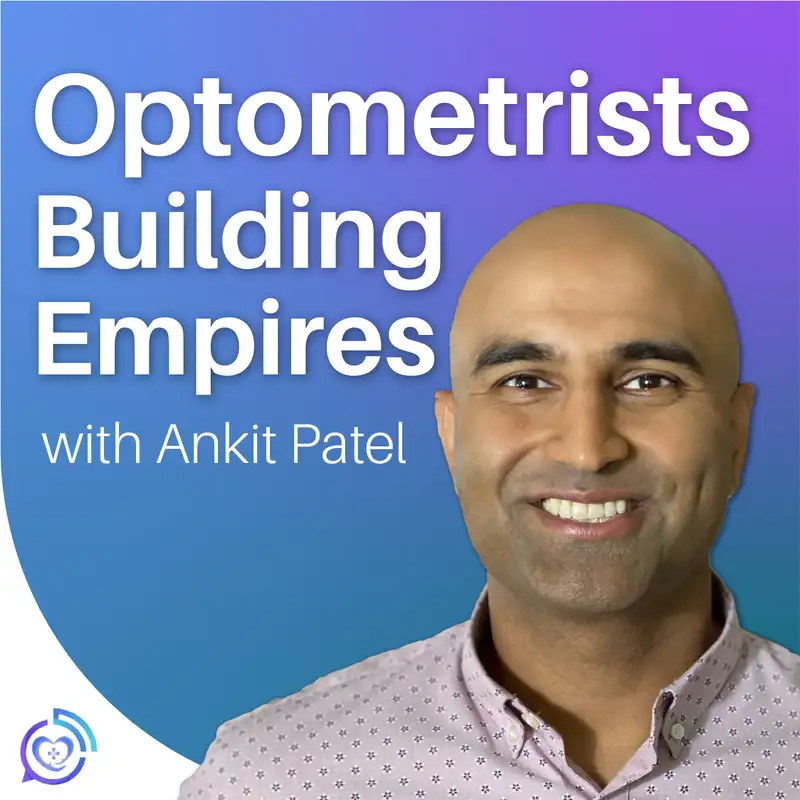
People, Purpose, then Performance - Dr. Rupe Hansra - Optometrists Building Empires - Episode # 095
OBE - Rupe Hansra
===
[00:00:00]
Dr. Rupe Hansra: I really focus in on, on two things. You know, one is finding the best talent on the planet, and two is, is driving culture.
I hate to use the word hold somebody accountable, but how am I gonna drive accountability if, you know, if the goalposts are moving constantly and they don't really know-- the employees really don't know what to do?
what we came up with in terms of our internal mantra of how we wanted to lead was in this order: people, purpose, and then performance.
This is Optometrist Building Empires, and I'm your host. I'm Kit Patel. Each week we'll explore the journey of practice ownership and leadership in optometry. Join us for insights and strategies from the top minds in our field. This show is sponsored by my business care team. My business care team helps your office increase revenues, reduce costs, and reduce staffing headaches.
Let's build your empire together.
Ankit Patel: Today's guest is someone I'm excited to introduce you all to and learn from. He's a sought-after [00:01:00] leader at the intersection of clinical excellence, medical device strategy, and large-scale healthcare operations. an innovator who is reshaping the future of eye care through the power of AI and connected technology. He's a passionate advocate for charitable vision care, having dedicated time to OneSight and Eyes of Hope clinics, bringing sight to under-served communities throughout the world. also vice chair of the Illinois Eye Institute, and
Dr. Rupe Hansra: Yeah.
Ankit Patel: of professional affairs at Topcon Healthcare. I want you to please welcome Dr. Roop Hansara. Roop, welcome.
Dr. Rupe Hansra: Hi. Thanks, Ankit. Uh, super, super glad to be here, and thanks for that wonderful introduction.
Ankit Patel: I'm, well, I'm super excited to talk about your background and, and, and I wanna give the audience a little flavor for how you think. So w- with that, what is the most important thing that helped you grow your empire? What was your root cause of success
there?
Dr. Rupe Hansra: the root cause of success really for me is, is the common thread really is around change. So if you wanna drive [00:02:00] scalable change, I think it has to be rooted into, um, i-into a purpose. And for me, that was driving, uh, quality of care, enhancing the patient experience, and then enabling sustainable practice growth.
So all three need to be working in sync. So I kind of look at it as a three-legged stool.
Ankit Patel: Yeah. So let's, um, let's talk about, um, where and how that helped you in your career. So tell us a little bit about your background, 'cause right now you're doing a couple exciting things with Topcon, with the, with the university, but tell us how you got to this situation
Dr. Rupe Hansra: Yeah, it's been-- I've been very lucky. I've had a lot of great mentors, and it's been a very, very interesting career. Actually, I started out, I'll go even way back, I was actually admitted to the seven-year dent program at Marquette University, and I decided that really wasn't for me, and I just loved the concept of optometry, being able to not only see patients but see families, and then, uh, really understanding this link between your eyes and your overall health, I found to be quite [00:03:00] intriguing.
Uh, practiced, um, you know, between Chicago and California for about ten years, and I went over in a, in a leadership role, uh, back when it was just Luxottica. So I ran the Bay Area, uh, San Francisco, um, had a territory, um, from Minneapolis to Corpus Christi, did some things in strategy and operations for North America for Luxottica, had a stint at GrandVision in- Was lucky enough to, to go to Visionworks, uh, for about six years.
And finally, you know, part of, uh, my agreement was with Visionworks was to be able to get into a, into a PC or something like a joint venture with them that I scaled 20 locations.
Ankit Patel: Yeah. So y-you've got... You know, it's, we talk about different ways people build empires, and yours is a unique path. All right? Uh, uh, you said, did I catch that right? Seven-year dental school program? Was
Dr. Rupe Hansra: Yeah, it was an accelerated s- uh, seven-year dental pr- uh, program. So they admit you as a, as a freshman and undergrad, and then you, you're automatically admitted after three years if you keep up a grade [00:04:00] point average.
Ankit Patel: Oh, that's it. And then, so you went to optometry, and you worked in, uh, corporate and, like,
Dr. Rupe Hansra: Yeah.
Ankit Patel: kind of worked your way up, and eventually you were in charge of 20 stores for Visionworks. Is that right?
Dr. Rupe Hansra: Uh, yeah. So those are-- that w- those are my practices. So, you know, in terms of, of being able to have multi-unit, that, that is my specialty. So, you know, anywhere between, you know, 500 to 360 locations, depending on the, the position that I had across the country. But these 20 locations we actually scaled, I think I inherited one and, and 19 were de novo that we actually opened up in Seattle and then, and then California.
Ankit Patel: That's amazing. And d-de novo, uh, is a r- cold start,
Dr. Rupe Hansra: Cold start. That's exactly right. Yeah.
Ankit Patel: Yeah. Um, for j-just in case. I, I didn't know. I had to look up that term the first time you told me. Uh, the, the, um... A-and so, uh, when you talk about your root causes of success, your, your things that made you successful, how did that, how'd that work out when you were growing your, for, to your 20 practices?
Like, tell us, like, some s-stories of why that was [00:05:00] effective, when you had to make tough trade-offs and to follow your, your, your thesis. Like, te-tell us about that a little bit.
Dr. Rupe Hansra: Yeah. And so I, I think that, you know, I believe that there's really two markers for success. I try to keep it very, very simple because, you know, when you have one location, you're on site, you can control a lot of things. And you go to two locations, you're there 50% of the time. Three locations, you're lucky if you're there 30% of the time, and then so on and so forth.
So I think if you wanna drive execution, you have to keep things simple. And so for me, I, I really focus in on, on two things. You know, one is finding the best talent on the planet, and two is, is driving culture. So when it comes to talent, uh, there is a... It, it's a terrible book, uh, but it has got great principles.
So it's like a 400-page book called "Topgrading." And what they talk about in "Topgrading" is finding the, the top 10% of talent, uh, within that salary range for that particular position. So I was [00:06:00] very relentless in terms of finding the right talent, um, for the positions that I was trying to fill. And then when I'm hiring, uh, Ankit, I'm looking for Uh, people that would fill certain competencies.
So the number one competency I'm looking for is alignment to my vision, then I'm looking for drives for results, looking for emotional intelligence. And then depending on the position, usually if it's a managerial position, I'm looking for critical thinking skills, and then finally the ability to manage talent.
So that's on the talent side. And then on the culture side, I really try to focus in on, uh, driving w- through results with and through people, purpose, and performance. So once again, um, if it, if what we're doing doesn't deliver, uh, enhanced quality of care, uh, doesn't deliver great patient experience, or isn't about growing the practice, then I would really question the motivation of are we doing the right thing?
Ankit Patel: I love that. And [00:07:00] w- we, we've implemented top grading too.
Dr. Rupe Hansra: Oh, no.
Ankit Patel: robust. It's like 50 different categories. The
Dr. Rupe Hansra: Yeah.
Ankit Patel: three hours long, but man, they're amazing. those interviews were amazing to find out things about people you never would've known otherwise, and patterns that you recognize. There is another book by his son, I think Geoff Smart wrote "Topgrading." Brad Smart, his son, wrote "Who,"
Dr. Rupe Hansra: Oh, I haven't...
Ankit Patel: version of that. I'm glad you know the book because not very many people know the book, so I actually am gonna write that down as a matter of fact.
Yeah. Yeah. "Who" by Brad Smart is a simpler version of top grading that probably d- gets you 80% of the way there. Um, it, it... And you know, you, you said it yourself, right? A... Basically, you're looking for people who are drivers, A players, who also make sense of the situation you would make a sense of it, and can hold accountable. And so instead of measuring on all 50 dimensions, you would just say like, "Give me the three or four that really are good, and let's look for that." but l- let's talk about that a little bit. So culture, uh, i- if, you know, it's easy to look back and some people might say, "Well, yeah, that's great if I had 20 locations."
When you had one, two locations, how do you, how do you implement that, right? 'Cause then you're, you're just worried about, [00:08:00] "Okay, can I... Do I have enough patients? How do I
Dr. Rupe Hansra: Oh my God. Yeah.
Ankit Patel: with like different problems at that
scale.
Dr. Rupe Hansra: you have-- Um, you, you're exactly right. I mean, you have to start somewhere. And I think what culture allows you to do, and starting small is actually perfect. You don't wanna start big 'cause it's hard to change culture when you inherit something. If you're building something from the ground up, you know, you are the one that is, is setting the tone for the culture.
And the way I look at culture is, you know, culture is designed to create self-directed behavior. Because if I have to, uh, script out for you each and every single behavior and what to do in this situation, and I've been part of organizations where we've had people come in from the outside and they wanna draw up all these scenarios, and they get bigger and bigger, and this is how you answer the phone, and this is how you greet a patient.
But, but then again, it's, it's so much to memorize. There's, you know, 100 things that you need to execute But if I [00:09:00] told you these are the, the three things that I, I need you to focus in on that I want you to benchmark or measure yourself against, and this is what I'm gonna coach to, I'm only gonna coach to three things.
I'm not gonna coach to all this. I think then you create this concept of self-directed behavior, and as you, as you coach the leaders, it's, it's, you know, the, it's the leaders that create the culture, and then you create the sustainable growth as the, as the, um, the leaders create the culture, and then the culture then creates further leaders, allowing you then to fill positions and then expand as you want to go to one, two, or three locations.
But yes, it's really scary when you want to open up de novo, you got a loan on your head. Where do you hire from? It's a n- you know, it's a new market. I don't know any doctors here. It's a, you know, it is a grind. It is a grind.
Ankit Patel: you know, it's funny 'cause w- w- what we look at now are sim- something similar like we, we have our routing tasks,
Dr. Rupe Hansra: Yeah.
Ankit Patel: your basic day in, day out jobs. Then we have our [00:10:00] sense-making. How-- Do you understand the problem the same way I see it? And, uh, accountability. Are you gonna take ownership of it?
And then the last thing for people managers is can you build capacity in other people to do sense-making and, and accountability? Um, so it sounds like you had a similar philosophy.
Dr. Rupe Hansra: I, it's exactly right, and it's, it's funny that many of us, we may call it different things, but it's very, very simple. And so, you know, generally when I'm looking at talent, and we see it in a lot of the books, they simplify it into will or it's skill. If I was to take that as a pie, I would put it as will, skill, culture, accountability, and then capability would circle that or, uh, enablement to your, to your point.
So when it comes time to, um... I would say, you know, what, what do you control as a leader? Can you control the type of talent that you hire? But if you want to scale a business, the capabilities or enablement, the systems that you put in place aren't really dependent-- uh, aren't really driven by the employee.
That's driven by you and [00:11:00] your vision. So when results happen, I kind of look for those things, will, skill, culture, accountability. But then there is a, there's a DNA component where I have to look in my i- uh, look in the mirror and I say, "What is my DNA on this? Is it the systems that are in place? Is it the business model?
Is it the capabilities that are there as well?" And, you know, am I coaching and to the level that I need to be coaching to? Am I setting standards to the level that I need to be s-setting standards to? Because how am I gonna hold somebody, um... And, and I hate to use the word hold somebody accountable, but how am I gonna drive accountability if, you know, if the goalposts are moving constantly and they don't really know-- the employees really don't know what to do?
Ankit Patel: Yeah. Yeah. Yeah, I think that's great insight, and finding someone that works with your working style too.
Dr. Rupe Hansra: Absolutely.
Ankit Patel: as you were growing your practices, uh, what'd you run into that you didn't expect? Like, y- you know, uh, w- what was surprising like, "Man, this was not what I expected. It was harder than I expected."
Something like that. What was a challenge?
Dr. Rupe Hansra: uh, give you a little bit of backstory. You know, w- [00:12:00] many years ago when I was a young OD, uh, I had the pleasure of, uh, of writing a few articles for Optometric Management Magazine, and Jim Thomas, who was the chief editor back then, I said, "Jim, you know, what are ODs interested in?" And that really hasn't changed.
He said, "Staffing, staffing, and staffing." So, so, you know, you go out, you recruit, you find the best staff, you onboard them, things are starting to hum. You got your people in place, and then the next thing you know, somebody says, "Hey, you know, I, I, I'm, I found another job," or, "I'm moving out of state," or, "I'm, you know, I'm, I'm getting married."
And so they wanna switch, and then you're starting all over again. And that, you know, I think we saw a lot of that during COVID. I mean, during COVID, you know, finding employees was at a premium, and you put an ad out in the paper, for example, or online, and people are ready to come in. You set the time, and they don't even show up for an interview.
Or they show up, they, they, you, you're ready to get hired, then they don't show up for the first day of [00:13:00] work. It was, it was just an incredible time, and there was, uh, you know, the competition, uh, not only for, for staffing, but for doctors during that time was, uh, was at a premium. And so I think staffing is always unexpected, and you really have to have some thick skin.
And, you know, it is, it's a choice. It's a personal choice whether somebody wants to work, uh, with you, and you have to be able to respect that, and you have to be able to create an environment that people actually want to work with you as well. But, but the staff turnover is, is always the hardest thing for me.
Ankit Patel: it's funny. Uh, you know, it's always, uh, even... I can't tell you how many times I know that lesson, and I still have turnover, and I'm still hurt by it
Dr. Rupe Hansra: Yeah.
Ankit Patel: believe that." And I know it's gonna happen.
Dr. Rupe Hansra: Yeah.
Ankit Patel: natural order of things, right? Um, but yeah, it's al- it's never easy it seems like.
It, it always seems a little personal for me at least.
Dr. Rupe Hansra: It, it, it does feel very, very personal. And, you know, again, when I was a younger OD, I had a, I had a situation where [00:14:00] I wanted to leave. And my, uh, my supervisor was an OD. He, he's somebody that I aspired to back in Chicago, Mark Jacquot. And I wanted to move to California. And Mark was, you know, "Roop, I'm sad to see you go, but at the same time, I'm really happy for you because I want you to, to, to chase what's out there and explore what else is out there."
And so, you know, that was a really good lesson to me because it's, you know, it's, for a guy who's got a lot of drive and who's competitive- That's really not intuitive to my thinking. It's something that, you know, through mentorship, you have to be able to shape that thought. And I, I use that as an example, uh, for when, you know, for when doctors want to leave.
Um, you know, my goal is, is I, I-- when I hire folks, I try to develop them. So I have a quarterly develop- development program. So maybe we start with situational leadership, we go into fierce conversations. But every quarter, you know, we have, um, [00:15:00] almost-- it's almost like getting an M- an executive MBA. You know, we, we got a core group of doctors.
Um, we, we have, um, you know, a, a, a focus. There's a-- typically, there's a book or some leadership principles. We tie that back to what's actually happening in the practice, the behaviors that we want to change, and then tie that to a measurable result. And so they go through this probably for about six quarters.
I think that's where I feel very, very comfortable that they, they really understand the philosophy that I'm trying to build, but we're actually building leaders. So when then they just-- when they just say, "You know what? I, I feel like I've, you know, I've hit a ceiling with you, Roop. Like, what else is there for me?
I, I'd like to get a-- either I'd like to get a piece of the action, I'd like to do a role that you're doing," um, or by the way, there's a private practice that, that is down the street that I used to work at and they're selling. And the-- you know, what the most satisfying thing for me now [00:16:00] is to say, "You know, go ahead, spread your wings, fly away."
But when they come back a year, a year and a half later and they said, "You know, Dr. Hansra, we doubled the optical the first year I got it," that has happened to me, I can tell you m- more than a half a dozen times, and that to me makes me feel really, really great that like, this is what it should be about.
Like, I picked the right person. This person is self-motivated, they're driven, and they're, they're sustaining this, this concept or this philosophy. And so I, I couldn't be more happy for their success.
Ankit Patel: I, I love how your focus to scale is the people, people first
Dr. Rupe Hansra: Yeah.
Ankit Patel: I think a lot of times we think like, "Am I offering the right things? Do I have the right equipment?" Which are, those are all baseline things you need, but your path for growth was all around people focus and sys-system focus secondary with people first.
Dr. Rupe Hansra: Yeah. And, and I think, um, you know, thinking about these 20 locations that I had, I had a great business partner, uh, Sam [00:17:00] Campos, based out of Sacramento, and what we came up with in terms of our internal mantra of how we wanted to lead was in this order: people, purpose, and then performance. I mean, we can pull up Power BI and take a look at what the results are.
I mean, you've got a business degree. I always say doctors are scientists. It's not very difficult for us to go into Power BI, pull up the results from yesterday And do an analysis of that. And so generally, what ends up happening is we start focusing on the end result as opposed to start to work with the people.
And, you know, so often when you, when you pick up the phone and you, you, you call the, you call the office, and I s- and I say, you know, "Nicole, how are you doing?" And she goes immediately to the results. "Well, you know, yesterday we only had seven exams, and this is what happened." And, and you know, the, the question wasn't what were the results yesterday, the question is how are you doing?
And so, you know, s- it, [00:18:00] it took a, a long time because we've been-- we've sort of ingrained people to start thinking this way, that your value is only as good as the results that you deliver, um, that you as a person doesn't, don't really count. And so we really focused in on people celebrations. So generally every, every office visit, every, uh, conference call that we had, we generally did a, you know, a large conference call, usually on a Tuesday or Wednesday morning.
We always started off with people celebrations, and that could have been somebody got married, somebody went on vacation. We, we put their, their pictures up there. Someone had a baby. But we always started with people celebrations, and then we went into the purpose. And the purpose is, you know, it, it... it was a lot of storytelling.
So it wasn't about what was your retinal imaging percentage, but let's talk about, you know, was there any great stories from last week? And you would be surprised. People don't feel comfortable sharing the stories where they [00:19:00] saved somebody's life, they detected. Could be something as simple as background diabetic retinopathy, but this patient wasn't even aware that they were diabetic.
And now what we can do is we can get them to their internist, get them on, uh, get them on a, on a sugar pill, diet, exercise, you know, GLP-1 agonist, whatever it might be. But we're sharing these stories and, um, even the busiest times where, you know what insurance week is like, that week 51, week 52 benefits are running out, and we're just saying, "Oh, we gotta take all these patients."
Well, guess what happened? I can remember at Dr. Singh's location in, in Tukwila, um, she had a 19-year-old kid came in there. Um, and, and turns out he had some, uh, had some rot spots in the back of his eyes and sent him out to the emergency room. He was completely unaware of it. Saved this, you know, saved this patient's life.
And then when she shared that, all of a sudden a bunch of different doctors started to share, "Well, I saw this this week," and it did become about insurance week. [00:20:00] We never lost our mission or our vision of what we're trying to achieve. So it's people, purpose, and then performance. Because I think if you do those two things, again, you get that self-directed behavior and all of a sudden you create a great experience.
Patients do wanna come back. and, at the end of that exam when they say, "Dr. Patel, I just, have one question for you." "Well, what's that?" "You know, can you be my doctor next year as well?" I mean, when doctors tell me that's, that's how some of their exams are ending, like, it, it-- you, you know that you're doing the right thing as a leader and you're creating the right culture.
Ankit Patel: That's amazing. like a really fun place to work, actually. Um, w- so, so why, why, why the transition? I mean, y- you know, you could have stayed and do that. What was the genesis and the drive to, to
change?
Dr. Rupe Hansra: first of all, let, let me share, I, I, I loved my exper- absolutely loved my experience at all the companies I've worked with, particularly at, you know, at Visionworks and, and VSP. They were very, very kind to me. [00:21:00] Uh, I love the mission and purpose of those organizations, the leadership there. When you, when you start to grow and you, you get in this cadence and this rhythm, you know, we, we were doing very, very well.
And, um, prior to my, uh, to my taking on these locations when I was in strategy and operations at Visionworks, I had, um, I had, uh, Ali Tafreshi and Chris Lee from, uh, from Topcon Healthcare, um, give me a ring and they said, "You know, you guys have 200 OCTs. What are you doing with all of the data?" And I, I said, "I, I don't know.
Like, but let's, let's go ahead and talk about it." And in my mind I'm thinking, yeah, we have a lot of patient data, CRM, demographic data. And, uh, Ali, who's now the CEO of Topcon, uh, Healthcare, said, "No, no, no. Like, I, I wanna talk about building a real world database." And, and I said, "Well, what do you mean by that?"
"Well, with all these retinal images through AI and big data, [00:22:00] we can take your image and compare it to, you know, a million other eyes, four million other eyes, and we can draw out these healthcare insights, both systemic as, as well as ocular. But in, in order to build these AI algorithms, we need lots and lots of data sets."
And so proud to say, you know, and thankfully, you know, Visionworks and VSP, uh, were very, very kind about that. And, you know, we, we were the first to sign, uh, a data sharing agreement. Since then, I know many others have, including Illinois Eye Institute and I know, and, and, and others. Moorfields Hospital, uh, has a, has a data set that they're contributing along with the NHS on, you know, with, with, with some biobanks there.
Uh, but I think for us, again, it was like this whole new world of, of, you know, oculomics. And, you know, we've always known there's a link between your overall health and your eye, and I, I stated that earlier. I, I can even remember Scott Jens, you know, my, my first day in, uh, at ICO, and [00:23:00] Scott Jens, who was a fourth year, was talking about what are you gonna see in clinic?
You're gonna see diabetes, you're gonna see high blood pressure, and you're gonna be diagnosing patients that have glaucoma. So it wasn't just contact lenses a-and eyeglasses. There's this, there's this systemic component and ocular component- That is out there. But now imagine a world where you go in and most of us are, are, are, are taking retinal images as a wellness screener, but what if we're able to run an AI model in 30 to 60 seconds, come out with these healthcare insights?
That's what Ali was talking to me about. And so, um, when my time in, in, in, in strategy and operations were, were up and I started to open up these practices, I did a little bit of consulting, uh, with, with Topcon Healthcare and Ali, and the more I delved into it, this is really gonna change the entire healthcare system, and it's gonna be fantastic for eye care, um, both on the, [00:24:00] uh, on the ophthalmology as well as on the optometry side.
Because who has all these images and all this data? It's, it's not ophthalmology. Ophthalmology has all the sick eyes, and they don't wanna see the low-level, low-level cases. But who has all the data and is the entry point into this entire healthcare system? That's optometry. It's, it's not general medicine or primary care physicians.
Patients don't typically wanna go see them, but I turn 40, oh, I'm, I'm seeing blurry. I'm out of contact lenses. My glasses are scratched or they're broken. I gotta go see my eye doctor. So patients are much, much more likely to go to your office or c- or to come to my office than they are to go see their general physician.
And so op- optometry is the perfect place to be what I'm hearing this word of being the front door of the entire healthcare system.
Ankit Patel: Yeah, I think it, it makes sense because, uh, you know, the retina cells pick up on disease changes
Dr. Rupe Hansra: Yeah. Right.
Ankit Patel: doctor, but that's my understanding of being in the industry long [00:25:00] enough that it's a really-- it's literally a window into your health, right? Um, and so it can be pretty exciting.
It's-- And I, I've, I've heard of really interesting things like heart health, um, other, like kidney risk, uh, diabetes obviously, but all these other things that are coming out with OCT scans that might have correlations and causation linkages based off of scans that you can pick up earlier.
Dr. Rupe Hansra: Yeah, and, and there's different ways that we can do that, and you're exactly right. And so probably in terms of, like, what are the, what are the big costs on the entire healthcare system right now? You know, Americans, we continue to get sicker and sicker. One out of six Americans has some type of chronic disease.
One in five Americans hasn't seen their general physician in over five years. And, you know, cardiometabolic, we, we're-- again, if there's 98 million Americans that are pre-diab- already have pre-diabetes or metabolic syndrome, and there's 330, 340 million Americans, that's a, that's an epidemic. And so cardiometabolic risk is I, I believe that that is the, that is the number one driver [00:26:00] of healthcare costs in this cou- in this country.
And so if we can identify these patients early and then get them on a treatment plan Much cheaper to put somebody on a statin or on a GLP-1 agonist, uh, or diet and exercise, get a gym membership and start w- start doing that, as opposed to an un- unexpected hospital stay or doctor visit, wait until you have a stroke or a, a, a cardiac issue.
Uh, it's, it's, it's not only devastating for that patient, their health, their quality of life, they miss work, people have to take care of them that are at home, but then the burden it puts on the entire healthcare system is
Ankit Patel: And,
Dr. Rupe Hansra: tremendous.
Ankit Patel: and I want, I wanna build on that because you have a unique purview. You've done the big practices, really a lot-- really good access to healthcare, 20 locations. Now you're on the equipment side and really on the cutting edge. Um, I don't want this to be, uh, you know, before this go- Topcon doesn't sponsor this podcast.
I'm just excited to have you on. This is, uh, not necessarily a, a Topcon commercial, but what are you [00:27:00] excited about from your personal perspective about what's happening in the industry? And maybe talk a little bit about what Co- Topcon is doing as well. Uh, because I, personally, we use them at our offices too.
We love them. Um, but you know, again, we had no-- we just personally had a good experience with them. But like, tell, tell us about what you're excited about
Dr. Rupe Hansra: I-- and I love that question. I'm excited about a lot. I, I, I had to say goodbye to my 20 locations that I built up from scratch, and I, I did so willingly because I am very, very excited about the future of eye care, the future of healthcare through Oculomics. Um, in general, speaking big and broad, uh, sometimes when I give presentations, the very first slide I show is actually a picture from 1933 from the Wisconsin Historical Society.
It's a picture of an eye doctor, a patient, an exam room. You see a chair, a stand, you've got some trial lenses, a chart, a keratometer, and phoropter and all that. And, and that picture again was taken in the year 1933. And, you know, a lot has changed in, in [00:28:00] since 1933. In the minds of our patients, maybe not so much, but we know that there's breakthrough pharmaceuticals, there's new surgical techniques, there's...
We can image, to your point, down, uh, to the micron level with OCTA. Um, so a lot has changed in over 100 years. But there's one thing that hasn't changed that I'm very, very excited about that Oculomics is gonna break these barriers, is that optometry, eye care, we continue to work in a silo. We've been working in a silo for 100 years, and, and that is the same for many, many practitioners overall.
Interdisciplinary, we kind of work in our little silos. And so I think what Oculomics is gonna do, it's gonna break those silos down in a, in a major, major way. So imagine, what are the AI models that are gonna be coming out? So we know that there's, there's three diabetic models that are, that are out there right now.
Those are- Those are primarily for general medicine. Um, I... You know, you've got [00:29:00] diabetes, you don't go to the eye doctor. 30 to 60 seconds, I have a robotic camera, it puts out a report. I can tell you if you have more than mild diabetic retinopathy, and if you do, I, I need to refer you out. Now, 90% of those referrals don't need to go to, uh, ophthalmology, which is already overburdened.
Um, but that needs to go out to your office, and that's a $200 medical referral. And so we can make this, we can make this, um, uh, where, where everybody, um, can actually get paid through this and incentivized. Uh, unfortunately, a lot of the in-incentivization is through a reimbursement, but we can incentivize people along the way.
Your office then can triage those patients, um, because we're gonna raise, we're... You know, what does it say? The rising tide floats all boats. We screen more people. You'll have some of these people come into your office, and then when the time is right, you can then send these patients over to retina. And so they can take on the surgical cases, which may be a $2,000 case as opposed to a low-level [00:30:00] background diabetic retinopathy patient that they, that they're already overburdened with.
And we know what the wait time is to get in to see a retina specialist. It may be th- three to six months in, in some cases. So we know about the diabetes model. So there's, um, Tuku has a couple of different models. One is called, uh, CLARE for cardiovascular risk disease. It gives your 10-year risk score for atherosclerotic cardiovascular risk disease.
It's a binary score based off of 50 different biomarkers and about four million-plus retinal images. It is right now going through FDA breakthrough status, so it's not approved in the US yet. It is approved overseas. They have a My Kidney AI model, which again, is in FDA breakthrough status. But then start, let's start thinking about Parkinson's, Alzheimer's, uh, preeclampsia.
I mean, things that you may or may not even be thinking about. And then what about PTSD through, uh, through eye [00:31:00] movements? Uh, depression, ADHD, all these things are gonna be coming, and you'll be able to screen for these right at your office. And then on top of it, there's home monitoring components to it as well that, you know, ODs we don't really...
We think of, "Hey, I wanna see you back in 28 months when you need your next pair of eyewear." That's typically when people come back, or 15 to 18 months for contact lenses. But now I can continue to engage with you throughout the year through home monitoring, let's say for, you know, for your AMD. Um, and so, um, that is what makes this very, very exciting for, for op-optometry.
And so we being the front door now, uh, we image these patients, we perform these tests They're positive. And so when you think about, let's just say CLARE or cardiovascular risk disease, um, "What brings you in today, uh, Ankit?" "Well, I'm here for an eye exam, and by the [00:32:00] way, the-- I, I saw you were on American Heart Association's locator app saying that I can get screened for heart disease."
Well, we can, we can do that too. So we, part of your normal workflow, we take the retinal image, we run an AI model through it, could be CLARE, and we come up with your risk score for heart disease. And if you don't, we have the conversation, we reinforce the good behaviors that you're doing. But if you do have, um, a, a high risk for that or an elevated risk, what do we do now?
Do we send you to the cardiologist? I don't know. I mean, do cardiologists want to see a level one patient that maybe they just need to be put on a statin?
Ankit Patel: Yeah.
Dr. Rupe Hansra: we have to then develop these relationships so we can triage these patients, and maybe it's a primary care physician, maybe it's a Teladoc, maybe it's a Quest lab that we send out these patients to before we triage them.
80% of US counties are, are in a [00:33:00] healthcare desert. One out of three Americans lives in a healthcare desert. These are the problems that we need to solve for, but we can't solve for it unless we scale this model. And again, going back to your building empire, we, we can't build an empire in a silo and without systems in place.
It's an ecosystem. And so what I mean by an ecosystem is you do something really well, you've got your discipline, I've got my discipline, someone's got a discipline. But when we start to connect these disciplines, the sum of the parts become greater than the whole, right? And so this, now all of a sudden we can achieve things that we weren't able to do by working in that silo like we've been doing for the past 100 years.
And so, you know, why would I give up 20 practices, uh, and burn the ships, so to speak, like the Vikings? Because I think that we're at an inflection point in the entire industry where optometry can play just a tremendous role in the overall healthcare system with and through Oculomics.
Ankit Patel: and [00:34:00] it's interesting 'cause, uh, the theme I'm gathering from what people are saying, what they're excited about, what I'm hearing is a consistent theme of, expansion of scope and more importantly, distribution changes. Like the how, how people come and the habits that they're building to come to see the eye doctor are changing away from just glasses and contacts to healthcare, which is exciting
Dr. Rupe Hansra: Yeah, and so I've done a lot of consumer insight studies. I have to be careful with what I'm sharing. But generally speaking, you know, about 15% of the people actually come to the eye doctor for a health checkup. They typically only come in because my glasses are scratched and broken- My glasses are scratched, they're broken, I'm seeing blurry, or I'm out of contact lenses.
So in effect, if I see clearly, I don't have to check yearly. And I don't know if you remember, that was the, uh, the Vision Council of America's, uh, going back, you know, 15, 20 years ago, that that was their, that was their motto or their tagline. You know, check yearly, see clearly. The problem is I'm not gonna go in un- unless I have a problem.
Now, for those 15% of the people that are [00:35:00] gonna go in for a health check, what generally drove those people to come in and see the doctor? It was somebody had an event within the family or somebody I'm close to that I've got an emotional connection to, and I... So now I view an eye exam differently. So for example, uh, my father, uh, had quadruple bypass surgery, so he had a, he had a cardiovascular event and they recommended he goes and sees the eye doctor.
Somebody, you know, has diabetic retinopathy close to me in the family. They go see the eye doctor. Somebody had cataract surgery, and guess what? I'm the one that had to put those drops in my mom's eyes, for example. So I've got... So I view the eye doctor, uh, in a much, much different light than either glasses or contact lenses, or I'm gonna only go to, go see the ophthalmologist when I have a problem, not for a preventative health check.
Uh, I think we have a lot of work to do to help people [00:36:00] understand that an eye exam is much more than a refraction. It's much more than a perm- a permission slip to spend $300, and that permission slip says minus three, minus one and a quarter, axis 180. So we've got a lot of work to do, and I think Oculomics, I think partnerships with American Diabetes Association, the American Heart Association, um, other advocacy, consumer advocacy groups, uh, I, I think the payers, I think the payers have to play a really big role, whether that is, you know, I don't wanna name them or call them out, not that they're doing amazing work, because they are.
Uh, but the managed vision care companies, the, the health plans, they all must come together, uh, a- you know, and not look at this just from an actuar- actuarial point of view, but look at this from a clinical and preventative and quality of life point of view, and how that impact makes on the entire ecosystem, the entire healthcare burden.
Ankit Patel: Yeah. so I'm gonna shift gears a little
Dr. Rupe Hansra: Please.
Ankit Patel: a-and I'm curious, you have a [00:37:00] really cool way of thinking of the world and seeing things. Your background's really interesting, so can you share with us a story that made you who you are today? Like something... Could have been when you were younger, but it's a formative story for you that really resonates, like, "Oh, yeah, that really affected me."
Dr. Rupe Hansra: f- first of all, I mean, many, many people that know me know how I feel about my father. My, my, my dad came here in, you know, in 1959 on a student visa, 23 years old. You know, my dad left home, uh, to study. He's a villager, um, you know, from the Punjab, and he left home when he was 12 years old.
Um, my, my grandfather, uh, was a headmaster, uh, back in Punjab, uh, North India. And, and, you know, he said to my father that the biggest gift I can give you is the gift of education. So my dad had to leave the village at 12 years old, take a train, go on the other side of the Punjab and go live with some relatives, and he never really came back.
He only came back for the summer. So he's very independent, really since he was 12, 13 years old. You know, thankfully, he had some great mentors who were very [00:38:00] kind to him. Um, through one of his friends, he ended up, uh, getting-- sending an application in, came, came to, to Chicago. That's where he, that's where he landed.
Uh, worked a couple, two, three jobs. Um, and there was a wonderful story that he shared with me, and this is, um, might take a little bit of time. I'll just tell you the, the short form version of it. But he went to apply for a job as a student, and he went into the office and the gentleman said, "Yeah, you have the job, but you have to, you know, you have to leave your hat at the door."
And my said-- my dad said, "This is not a hat, it's a turban." And he explained, uh, you know, you can imagine back in '59, the exposure just really wasn't there. And he said, "Well, you know, please come back in when you're ready to, when you're ready to remove your hat at the door." And so my dad couldn't find a job.
He's a struggling student, and I saw pictures of him, and he's like this skinny. And then he came back a couple of weeks later, still desperate for a job, and he said, you know, "Sir, please hire me." And he said, you know, "Sir, I, I can't do that. You have to leave your hat at the [00:39:00] door." And my dad said, "I just can't do that."
And so my-- what ended up happening was my, my dad ended up getting a job at University of Chicago and started working for a gentleman, uh, doing math and stats and things like that. Well, that person ended up, uh, winning the Nobel Prize. And so, yeah. And so, you know, when we, when we bump into obstacles, you know, we can easily have our ups and downs and we can quit and...
But to be able to persist despite obstacles, have that relentless pursuit of excellence and not sacrifice our values, we, we certainly have to be flexible and be realistic. But what's important to you, um, and what defines you as a person, you can't let those things go. And so, you know, my dad has probably been the biggest mentor for me in my entire life, and he continues to do so.
Um, but that would probably be the, the one story that I would tell you that, that has really changed my life hearing that.
Ankit Patel: Thank [00:40:00] you for sharing that. That's awesome.
Dr. Rupe Hansra: Thank you.
Ankit Patel: it's, uh, you know, it's, it's, it's amazing hearing these stories from folks. It's always curious. Uh, I, I love that. Uh, you know, and, and, and I think, um, uh, I, I'm curious because of you've had such good mentorship, good relationships with your, with, with your people around you, is there anything that you'd give yourself advice if you were starting off over again outside of OD school?
Like, what, what would you tell your younger self?
Dr. Rupe Hansra: Well, you know, growing up, you know, we were kinda trained to be risk-averse. Like, don't make too much, don't make too much noise, kinda stay within your lane, put your head down, grind it out, and all those things that, you know, get you through optometry school and get you the grades and, um, and, and help you make good decisions.
And, and I think that those are very, very important. The cultural values that we have are extremely important. And I would say don't let those values limit you. Explore those values even further and [00:41:00] set your sights and build skills that get outside of your comfort zone. I know that sounds cliche-ish, uh, and I think that, that, that is, that would be very, very valuable.
In some cases, I felt like I didn't bet on myself early enough. Uh, I think a lot of my leadership career probably could have started a little bit earlier. I could have switched roles earlier. Um, I wasn't sure if I'd be successful in the, in the next role. I had a little bit of imposter syndrome from time to time.
But lo and behold, y- you know, when, when you get into a role and it's am- it's an ambiguous situation, you know, you, you, you, you don't lose who you are because you change roles. You're gonna figure it out, and you just have to trust yourself. And to your point, you know, reach out, um, and, and find individuals that have already been there and done that and, and get their advice.
There's a, there's a great book called "Tribal Leadership." I'm, I'm sure you've, you've read that book already, and it [00:42:00] talks about why culture works or how people can be successful. And, you know, one of the, one of the stories that are in there is about, you know, when people get released from prison, how, you know, what makes you successful as you enter civilian life?
And they talk about having this triad of mentors, and they could be completely different. You know, they're not just the same three and they all group together. But I've got, you know, more than a triad of mentors. You know, one of the folks that I, I talk to on a regular basis now is, is somebody who really is a legend in, in, in eye care, and that's Dean Butler, you know, the founder of LensCrafters and Vision Express and many businesses across the world.
Um, Wally Lovejoy is another one who I reported to. He's an e- he's an economist and attorney. I regularly connect with Wally Uh, and then there's others, um, you know, that you may or may not know, but those two individuals in particular have played a, a, a tremendous role in my career, and I continue to, to just...
You know, sometimes it's a- calling and asking [00:43:00] about their family, and sometimes it's, "Hey, am I, am I playing this right?" And, you know, "Where, where do you see the future at?" But I think mentorship is extremely important and, and getting at least three people within your circle that you can, um, that you can rely on from time to time.
Ankit Patel: Yeah, I like that. Thank you so much. This is, this is action-packed, man. I feel like we could've went for like hours on this, uh, just diving into your experience. Uh, so i- if folks wanted to reach out to you, h- where, where, where can they find you?
Dr. Rupe Hansra: Well, um, you can follow me on LinkedIn. Um, that's the easy way to do it, and if you send me a message, I'm happy to, to respond to it. Uh, rhansra@topcon.com, R-H-A-N-S-R-A @topcon.com, and you can send me an email there as well.
Ankit Patel: Perfect. We'll put those in the show notes, folks. Well, Roop, thank you again for being a guest on the podcast.
Dr. Rupe Hansra: No, you're an amazing host, and I, I hope to be back soon.
Ankit Patel: Yeah, absolutely. And I wanna share a quick
Dr. Rupe Hansra: Sure.
Ankit Patel: Um, I'm trying to synthesize your experiences. Uh, so I heard people, purpose, and then [00:44:00] process
Dr. Rupe Hansra: purpose, and performance. Yeah.
Ankit Patel: in that order. But more importantly, um, the purpose seems like there's an opportunity to connect the purpose with the way the industry is changing with distribution and access to care. So maybe having doctors sort of think through that a little bit more of like, really is, is your purpose just seeing the patient in front of you, or is it really thinking about serving the community at a large, in a different way and looking at other ways to do that?
Dr. Rupe Hansra: That, that's absolutely right, and thank you again for clarifying all the thoughts that I have in my head. You did it so nicely.
Ankit Patel: Well, I think so. It was, it was really cool listening and hearing that and, and putting those together, so thank you for sharing.
Dr. Rupe Hansra: Thank you. Yeah. Hey, I'm gonna be in Atlanta soon. I hope we get a chance to connect.
Ankit Patel: Oh, we will. We will for sure. And th- thank you audience for listening. Uh, if you learned something, laugh, please share the podcast and make sure to subscribe so you don't miss an episode. And if you see the link for a meeting, uh, please, uh, if you sign up for a meeting, I'll send you a free copy of my book. And again, thank you again, Roop, for being on the podcast. This has been another exciting episode of Optometrists Building Empires. We'll see you next time.
Dr. Rupe Hansra: Bye-bye.
That's a wrap on another [00:45:00] episode of Optometrists Building Empires. Thanks for joining. For show notes and more Visit Building Empires live. This show is proudly sponsored by my business care team. My business care team was born out of staffing challenges. My wife and I faced together managing multiple optometry locations.
We refined our approach at classic vision care and now offer our expertise dollars. If you're experiencing challenges with staffing and you'd like to set up a discovery call, we'd be happy to help you and connect you with the right resources. We'll see you next time.
Creators and Guests