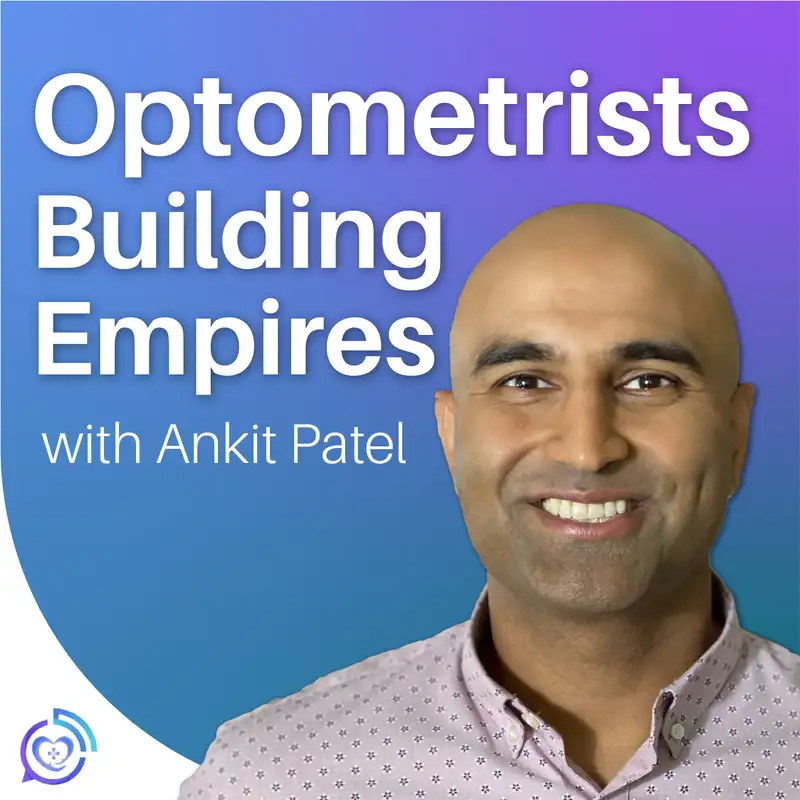
Fundamentals Matter More Than New Tech - Justin Coleman - Optometrists Building Empires - # 081
OBE_Justin Coleman
===
Justin Coleman: [00:00:00] your gut will give you an idea of how to feel about it, but it doesn't. Your gut is dumb. I went seven and a half years with zero turnover,
Your staff is part of your family, um, whether you like 'em or not sometimes.
eyecare is a primary care or optometry is a primary care aspect, and the whole family usually comes along. So I would say that one holds true no matter where you are. there is no such thing as perfection. You can only make small changes for the better.
This is Optometrist Building Empires, and I'm your host. I'm Kit Patel. Each week we'll explore the journey of practice ownership and leadership in optometry. Join us for insights and strategies from the top minds in our field. This show is sponsored by my business care team. My business care team helps your office increase revenues, reduce costs, and reduce staffing headaches.
Let's build your empire together.
Ankit Patel: [00:01:00] Today's guest is someone I'm excited to introduce you to. Coleman is the owner and lead optometrist of a three location private serving central and eastern Kentucky. Originally from Pikeville. Deep in the heart of Appalachia, Justin began his career as an industrial engineer in the automotive industry before pursuing optometry. Today, he focuses on delivering high quality patient care in communities where access to healthcare is limited. 2017, he's built in efficient values driven healthcare organization. With experience in practice growth, succession planning, and operational strategy, Justin is passionate about helping independent clinics stay competitive in a rapidly changing healthcare landscape. He also enjoys mentoring, emerging doctors and creating systems that empower teams to do their best work when he is not in the office. Justin loves spending time outdoors, woodworking, tinkering with classic cars, and raising his three kids. welcome to the podcast.
Justin Coleman: [00:02:00] Thanks for having me. Glad to be here.
Ankit Patel: Yeah, you're, you're, uh, you're a man of my heart.
Uh, we're both industrial engineers by trade, so I'm
Justin Coleman: Yeah,
Ankit Patel: to this,
Justin Coleman: we talked about that. Yeah. The automotive industry is its own, it's its own beast, but
Ankit Patel: sure.
Justin Coleman: Took Alon from it. So it was, it was good experience.
Ankit Patel: Well, let's dig into some of that. So, what was the most important thing that helped you build your empire?
Justin Coleman: to be quite honest, it's really just sticking to the fundamentals. Uh, it, it is being able to deliver care in a very consistent way. Um, really, You know, not getting lost in the weeds of all the shiny new trends that are coming into the office. It, it's really just doing. Well, each and every time and, and consistently, not just myself but my staff, and that's gone a long way.
Uh, the other caveat to that is really it's, it's been focusing on the kids. Um, because if you. If you win the kids over, you [00:03:00] win the mom over. If
Ankit Patel: Hmm.
Justin Coleman: Mom likes you, then she'll bring the rest of the family. So that has kind of been the spur of growth. Um, You know, mothers and a family are typically the healthcare deciders, uh, for the groups.
So, uh, it's really about capturing those, uh, sentiments along the way.
Ankit Patel: I like that. And, I'm curious, let's build on that a little bit.
Justin Coleman: Yeah.
Ankit Patel: Would that, would that be different? I know rural, practicing in rural areas is a little bit different than cities. Um, would that be a different strategy you might take in the city? I'm just curious the way you would think about it. I.
Justin Coleman: Um, yes. Uh, two of my practices are pretty rural, uh, small towns outside of Lexington. I've got one office. It's the smaller and newer one. Uh, it is on the edge of Lexington, which is a large town, small city, however you wanna call it. You know, it's, it's right in the middle. And it's definitely got a different vibe.
Uh, I would say it's kind of across the [00:04:00] board if you're, if you're, You know, eyecare is a primary care or optometry is a primary care aspect, and the whole family usually comes along. So I would say that one holds true no matter where you are. Um, the certain states require kids to have a, an exam before they start school, uh, dental and vision.
And that has been part of the practice growth, not only of public service, uh, public health initiative, but uh, it gives an opportunity to really get into the family and establishing rapport so that you can be a trusted member of their healthcare team.
Ankit Patel: Yeah, I like that. And you're not just focused on one, you get a whole family, so you're like, You know, three, four, maybe five plus. Um, yeah, we had one, uh, patient who I think had 11 in the family, so Yeah. Yeah, it was, it
Justin Coleman: Yes. Sometimes they bring all of them for just one exam and then it, it becomes quite crowded.
Ankit Patel: Yeah, we had, we had to make sure we had enough seats available.[00:05:00]
Justin Coleman: Yes.
Ankit Patel: Um, so what'd you, what'd you run into as problems that you didn't expect growing this business?
Justin Coleman: Oh my gosh, everything, uh, You know, when you wanna practice, I, I always call myself the chief cook and bottle washer. Uh, it is, everything comes up from staffing issues, um, uh, things that are just outside of your control. Uh, things within the business, uh, difficulties getting loans assessed, and all the hoops you have to jump through.
As well as making sure just everything is running smoothly. Um, we had our roof blown off, uh, a few months ago, uh, a little bit, and I had to have it replaced, You know, that stopped some patient care for a little bit. Uh, with the new practice trying to move into a new building. All of the, uh, loan acquisition things I've had to grow so much and learn along the way that really the thing I've been fighting has been my own lack of experience.
Ankit Patel: Say, say more about that. Where do [00:06:00] you, because I mean, look, coming from engineering background, project management background, you, you see Alon of other stuff that other doctors haven't seen before. 'cause you were in the business world. what, what did, what were some of the things that you even still didn't expect?
Justin Coleman: Uh, You know, there's certain things that just doesn't get, uh, brought up in school because it's not an entrepreneurial school, it's an optometry school. You know, your goal is to come out to be a proficient doctor. The rest, you do have to learn along the way. And despite me, You know, my. Business background and project check management in the past.
Some of the internal mechanism, uh, mechanisms of banking. Uh, I had no idea what it would take to really build a practice or to buy a practice, even, uh, how to go about looking at the loans, developing a pro forma, trying to figure out does this make sense from a financial or numerical standpoint? When to bring on more staff or such as other doctors.
You know, there are some formulations out there. It's more than just a gut check. It is [00:07:00] Alon of things. You have to run the numbers, you have to see if things make sense financially well ahead of time, uh, on the legal side of things, how to analyze a lease. And it's, You know, the general advice is just hire a lawyer.
How do You know what they're telling you is correct? Uh, so there's Alon of things I've had to learn from the school of hard knocks. Uh, I can't say that it's all been easy. Uh, I did a cold start in the spring of 2020. Uh, my second practice we opened March 2nd, 2020 and we closed on the 19th. It was, uh, and then we were open for three weeks and closed for seven or eight.
Um. Those were scary times. Um, and, and some of the things that kind of came up along the way that I just did not expect and had to survive through it, which gave me a little bit more insight on how to run the practice a little bit more going into the future to buffer those [00:08:00] hiccups. Mm.
Ankit Patel: Yeah, that's, um, yeah, that's kind of, that have been scary. I think I talked to another doctor who had something similar.
Justin Coleman: Yeah. Mm-hmm.
Ankit Patel: but a separate situation. Yeah. That, that's scary. What, what, um, I'm curious, uh, if you would, if we can give some nuggets to the audience, what are some of those ratios?
Like, uh, hiring, how do You know, wanna hire someone? Or like, what, what, what are some of these ratios that you were like, oh wow, that's, that's actually a thing. Like, how do you,
Justin Coleman: Uh,
Ankit Patel: realize that.
Justin Coleman: you, You know, your gut check, uh, just kind of back of the napkin sketch, you can say, well, am I booking out? Am I completely booked out? More than I would say two weeks would be your minimum, but You know, if you're getting into that 3, 4, 5 weeks. Period. You need some added capacity. The, the demand is there.
It's just a matter of being able to fill it in a timely fashion. Um, my second office is actually facing that right now. I don't have room to expand at the moment, but it is something I'm keeping an eye on because we're booking out about five weeks.
Ankit Patel: Mm-hmm.[00:09:00]
Justin Coleman: Uh, so, You know, you do lose a little bit by not investing in that opportunity cost.
Um. Purchase practice of a practice. You know, there's Alon of deep dives that you can do when looking at a practice to, to buy, uh, such as buying somebody out or even buying into, yes, there are professionals and I would lean heavily on them because again, we, that's not what we want to school for. But there is some formulas you can kind of run, uh, a little bit more deeper analysis, but 60% of gross is your.
You know, back of the napkin sketch, uh, other, other things such as, uh, bringing on equipment, uh, your return on investment, You know, it's really looking at your past. Um, data. Are the patients I'm seeing, You know, how many of those would, uh, benefit or utilize this new piece of equipment? What's my reimbursement?
And, You know, divide that or factor that into your [00:10:00] purchase price and see how long that ROI return on investment is. Ideally no more than two years for most of your small to medium sized purchases. Ideally 12 to 18 months
Ankit Patel: I like that. That's actually super helpful insight. By the way.
Justin Coleman: If
Ankit Patel: even do that, that I think Alon of doctors will just buy equipment and be like, okay, if they build it, if I have it, they'll
come.
Justin Coleman: goal
Ankit Patel: no, no, don't
Justin Coleman: come.
Ankit Patel: Don't do that. It's expensive. Yeah.
Justin Coleman: Uh, there, I've made a few, uh, of those, You know,
Ankit Patel: Yeah.
Justin Coleman: Decisions as well and have lived to tell the tell. Uh, You know, the, the new shiny thing always comes out. The reps will promise the moon. That's their job. They are there to sell equipment, not to make sure you're successful with it. So some of that really has to depend on your own personal motivation and what you're able to focus on if you're bringing something in.
Focus on it. Don't just set it up, set it and forget it. You know, it has to be, you have to be mindful when utilizing any changes that you're doing so that [00:11:00] it doesn't become just one of those blips on the radar.
Ankit Patel: Yeah. No, I, I like that. Uh, and You know, it's interesting you talk about that, uh, it reminds me of some of this stuff we did industrial engineering with Q Theory, right? You have five. Weeks of Q, it's like you're gonna have Q abandonment, right? People are gonna leave and people you're gonna have a higher no-show rate, right?
And so it's the balancing act of like, do I spend the money and see more patients and You know, revenue wise. So I think that there's a whole, you could get really down in the rabbit hole of really figuring out the analytics.
Justin Coleman: It, it, it's not hard to do. Like I said, my Excel sheets are. Numerous. I, I'm currently in the middle of, uh, before this, uh, interview, I was working on some things for my, uh, couple of my offices looking for ways of increasing capture rate or at least maximizing our, our optical cells. Uh, and looking for just areas of improvement.
Uh, and that involves me looking at sales matrix of our lenses, of our frames, um, comparing year over year, uh, capture rate and seeing what. [00:12:00] Uh, investments I can make. Sometimes that's investment in staff. And, um, You know, your, your staff is part of your family, um, whether you like 'em or not sometimes. And, uh,
Ankit Patel: Sounds like family.
Justin Coleman: like family, they're just like family and, or, or your kids.
One of the two, uh. But, uh, the, uh, the investment in the staff is, is making sure that they're able to grow and, and to do their, You know, half the tools to do their job well. Uh, incent uh, incentivizing staff goes a long way, and sometimes that's money. And for us, one of the better tools that we've used was.
Paid time off. You know, most of my staff have young families. they're mothers with young kids, and we know how much time that takes, for doctor's appointments, this, that and the other. So it would be nice to have that, level of security for some of them. And [00:13:00] so when we do our monthly bonuses, sometimes we'll bonus a half day PTO, You know, four hours at a time just to have a little bit more freedom because at times that's more valuable than the money itself.
So that gives them a little bit of flexibility. And those type investments do cost money to the practice, to the, You know, bottom line. But You know, when you set those incentives up to something that's motivating, that does kind of provide ways for them to make their own decisions and to, help your practice grow.
Ankit Patel: It also, um, helps differentiate, right?
Justin Coleman: Yes.
Ankit Patel: It, it's not people value. It's like not everything is equal, right? Not everything can normalize to a dollar
Justin Coleman: Right.
Ankit Patel: Of PTO is, You know, I'll just make 20 bucks versus an hour of pay is 20 bucks, but the hour of PTO goes Alon further because they're like, oh, wow, I get time off too.
Justin Coleman: Yeah.
Ankit Patel: You get, actually get double benefit for, for the staff so it can go further.
Justin Coleman: It really does, and you kind of have to read your team. You know, they, and this doesn't work for all production [00:14:00] incentives. It depends on kind of what it is versus, uh, the people, You know, we do give them options, uh, too, sometimes it's four hours of PTO or a have, You know, four hours of straight pay bonus.
So they get to make their own decisions and we allow, they're grownups, You know, we, we let them make their own decisions and we don't treat them like, um. You know, children or You know that we know best what, what's good for them. So that level of buy-in, even though it's a constrained freedom, it is still a bit of freedom and that's appreciated by Alon of people.
Ankit Patel: So I, I'm curious, You know, three practices in rural, uh, arch, or no, sorry, rural
Justin Coleman: Yeah.
Ankit Patel: Not Arkansas. Uh, And so you have, uh, why, why the impetus of growth, right? Why, why not stick with one? Why, why, why grow?
Justin Coleman: Most everything I've done in life has not been by my choice. I've almost fallen into it. It's, it's kind of crazy. Um, I, I would, I would like to say things, You know, it, it's been fortuitous [00:15:00] accidents. Uh, the first office, You know, I really did want to. You know, go in and buy a practice. I came outta school.
That was my goal. It was beat into my head. That's where I felt like the biggest fit was for me. Worked two years at a retail, um, facility, and it was, it was a good learning, uh, experience. Don't get me wrong. I, I learned how to see patients very quickly and efficiently, And so there was Alon of growth I had to do during that time.
Uh, but then when I came out, I, I specifically sought out private practices that we're hiring with the opportunity for equity buy-in, buyout something. So I was tickled to death just to have one practice under my belt.
Ankit Patel: Yeah.
Justin Coleman: Then a retiring optometrist approached me and said, Hey, I'm gonna be selling my practice center or closing up shop.
He goes, You know, do you want to buy me out? And I said, eh, it sounds like a pretty good idea. Went through all the, jumped through all the [00:16:00] hoops, and found a place, got it set up. You know, it got everything all up to the loan, like I was ready to pull the trigger. Lesson learned. We didn't hammer down the firm numbers going into it as much.
It was Alon of on the backend. When it came, came time to value the practice. That's where we were at. Odds. Uh, I was. More realistic. Uh, I would think at the, You know, gross revenue, looking at your ebitda, You know, and, and for those not experienced with that term, it's your earnings before interest. Uh, uh, help me out here.
Um, what's the t?
Ankit Patel: Uh, to taxes earnings before, uh,
Justin Coleman: earnings taxes, depreciation, uh, and appreciation. Yes.
Ankit Patel: That's right.
Justin Coleman: Um. Anyway, so it's your way of kind of calculating your practice value. Again, 60% of revenue. Nice. Back of the back of the napkin. Um, he was valuing his years of practice Alon [00:17:00] higher than I was.
Ankit Patel: Yep.
Justin Coleman: When he backed out, I said this, I can't go any higher than that.
It just doesn't generate. He said, well, I'm out. I'm just going to kind of coast and see my patients anyway until I'm ready to close the doors. I was already, You know, knee deep into the situation. I said, well, it's a good opportunity. Let's go for it. I had already done all the work, so I pulled the trigger anyway and it's been successful.
Uh, the third practice, uh, kind of fell into my lap, um, as doctor was moving on to a different type of, uh, employment situation was wa was wanting to sell a small boutique practice. And, uh, one of the reps I'm very friendly with. As a note, be friends with your reps. Uh, they were, they are the biggest source of just your external, uh, information out there.
'cause they're in all the practices. Anyway. Told me about this office. I said, sounds like a great idea. I wasn't really ready at the time, but I jumped through the hoops, bought it, [00:18:00] and have been plugging away since. So I didn't set out to own three practices. It just kind of happened and when, when the opportunity arose, I just took it.
I did not say yes to every opportunity that's come up and that is just as important as. Saying no is as important as saying yes. There have been a couple practices that were not a good fit for me, both from a revenue standpoint, You know, they were older kind of stodgy practices. They were going to need more updating and quite a bit of investment, or they were a little bit further away geographically and would've taken Alon more time away from not only me and my household, but also my office staff.
I have to be cognizant of. What their work capacities are, what they're able to generate. I don't wanna set them or me up for failure. So I've had numerous opportunities to buy out a practice, uh, some retiring docs, and they're just not good fits for me, whether [00:19:00] it's because I just don't want to, or it's not a good deal, or maybe it's just not the good, not the right time.
So knowing. Knowing your current situation, being able to assess yourself without the rose colored glasses on and to be able to take stock in where you are will help you determine if the timing is correct, because a good opportunity can come up, but you just can't say yes right now. So you have to be able to make sure that's the case as well.
Ankit Patel: Yeah, that's, um, I think that's a big, uh, so I, I've heard someone say strategy is just as much as you decide not to do as it is what you decide to do.
Justin Coleman: Uh,
Ankit Patel: I,
Justin Coleman: one is a choice and you just have to be able to make a conscious effort, a, a very determined choice, whether it is yes or no. And, and, and again, run the numbers. Your gut is, your gut will give you an idea of how to feel about it, but it doesn't. Your gut is [00:20:00] dumb. You need to educate it. So don't do everything based off of the numbers because again, You know the numbers may look good, but it's, it just might not feel good.
And so at the very least, educate your gut, run the numbers, and that will help you make a better feel decision with your gut.
Ankit Patel: I like that. That's good insight. And so curious how you're dealing with some of the more common problems we're seeing nowadays with staffing. Um, uh, you touched on it a little bit. Can you touch on a little bit more of, especially in, in rural Kentucky, I imagine staffing could be a little tough.
yeah.
Justin Coleman: it has its moments. I, I won't lie in the two small towns, uh, You know. As we say, Pickens are slim. Uh, sometimes just the number of people, uh, available to work and, and have the skills or qualities that you're looking for. I was very fortunate with my first office. I went from the time I bought it, I went seven and a half years with zero turnover, so I did [00:21:00] nothing but grow staff and I kept everyone I had for.
Three quarters of a decade, You know, and, uh, my office manager has been with me. She started before I was an employed there, so she's been at this office 10 years, uh, going on 11. And so I think really being respectful of your staff goes a long way. It's cheaper to keep them if they're, if they're a good fit now, uh, finding new staff.
Uh. In a small town, word of mouth goes a long way. Uh, most of them have been referrals from other staff, uh, other people that work for me that knows somebody that knows somebody that has a good personality and. You can train skill personality. You cannot teach. You can't teach, want to. Uh, it has to be kind of how they're wired.
And you'll know pretty quickly, uh, You know, within the first 90 days if they have that, I won't say [00:22:00] entrepreneurial attitude, uh, but they'll, they'll really care about what they do, the good work ethic. Uh, I've had some staff that just were not a good fit and I, I wrestled with. Do I really just let them go and try to find a replacement?
Or do I really try to work with them and coach? Um,
Ankit Patel: Hmm.
Justin Coleman: I usually take the coaching approach. Uh, first I'm not the, uh, the, the, the higher slow fire fast type of mentality. Eventually you get a reputation, especially in a smaller town,
Ankit Patel: Mm-hmm.
Justin Coleman: Uh, and you run out of people to work with. Uh, everybody has the opportunity to learn to grow even.
As, as a person. And, uh, sometimes it's recognizing when somebody's not in the right role, they're still a good worker, but maybe where they are is not a good fit. So you can train and coach and, and work with them and sometimes you've just gotta [00:23:00] take 'em. What's an all So, uh, they, uh, they know I care for them.
And that really goes a long way.
Ankit Patel: And that, and that's something I noticed in general business, uh, that, You know, optometry and healthcare in general, it's more. You know, it's not doing these businesses that all of a sudden you've been around for five to 10 years, you're not gonna like triple your business next year. Right? Uh, barring something really crazy happening, like an acquisition or something like that, um, if you just have everything stays the same, it, it's gonna be hard to grow the business like really fast.
And so what I, what I find there is longevity of staff makes a difference and having consistency helps, uh, uh, the same patient see the same people. It's more of a community feel
Justin Coleman: That,
Ankit Patel: just transaction.
Justin Coleman: and the other thing to consider, it's a hell of a learning curve. I mean, uh, between all the, the insurance, the ins and outs of, uh, how frames and lenses are, what categories they're in, uh, what insurance goes, what, how are things build medically to their vision plans, et cetera. So we [00:24:00] always start any new.
Person work them from the ground up. Uh, they start teching. All they have to do is kind of by rote, work the patient up, do auto refraction, check the VAs, work them through, et cetera. Then they move up and change roles. We often cross train so that if somebody does leave, uh, we have somebody else trained in that role to kind of move up.
A position and, uh, allow for the new hire to take the easier role, such as, You know, uh, we just moved a couple of days ago, a couple of my staff at the Mount Sterling office, and each office kind of does this, uh, differently. But my main office, uh, two, uh, two of the staff members had been in the optical cells for about three months.
And two, uh, one was front desk, one was kind of. General tech float, uh, referrals, et cetera. Well, they swapped roles and we [00:25:00] moved them over. So we have people that are very fluent and efficient in the optical cells, which is a slightly different skillset, and some that are, have moved to the front desk that prevents burnout.
You know, you change it up after a while. Anybody gets tired of doing the same thing year after year. So adding a little bit of variety. Goes a long way. It helps me make sure that the personality's a good fit for each role and helps me really kind of see how each person can blossom or do well in each position.
And again, if somebody leaves because life happens, You know, uh, it's always a good to have those roles kind of filled so you're not really hurting for somebody.
Ankit Patel: Yeah, that makes sense. The, the, um, and, and I'm curious what your, um, Kentucky actually has a pretty wide scope that
Justin Coleman: Yes.
Ankit Patel: Which is kind of cool, which is nice. Um, yeah, so you can do Alon there. What are you most excited about with, with the [00:26:00] future of optometry and your practices? So I'll let you decide which one you want to answer first.
Justin Coleman: excited about, uh, there's Alon coming down the pike. Um, You know, from a scope standpoint, we are kind of on the upper end of what I would expect us to be able to do for quite a while, You know, um. With lasers such as yag, capsulotomies, uh, peripheral autotomies, um, lumps, bumps, removals, et cetera. You know, that has been a really nice tool for my offices.
I offer the laser procedures and, uh, we offer, one of my associates is doing most of the lumps and bump removals, so we're able to offer that to patients that. Have transportation issues, they don don't have to drive to the big cities. And so that bringing a, that level of care to them where it's needed and realizing that, You know, patients are, have their own life and needs and difficulties outside of your office, that is nice to be mindful of and they appreciate [00:27:00] that.
As far as optometry itself goes on the, on the bigger thing, um, bigger scale, there's a few opportunities we can make. Uh. Such as corneal cross linking may be available to us. Now that it's FDA approved, I think certain states have some scope flexibility, uh, if or when, but again, that's not really a large.
Portion of the population. So that's not gonna make or breaker practice. Um, same thing with the, um, LipiFlow type of lid. Uh, You know, uh, work and machines, they're more than happy to sell you plenty of those machines. I tell you that finding the right patient market that will be able to kind of handle that, uh, out of pocket to make it worthwhile.
It can be a challenge. Again, some doctors are able to do it in a small rural setting and some work in a, You know, bougie, uh, uh, more metropolitan area and struggle. So [00:28:00] that's one of those vibe checks you have to know whether you can do it yourself. Um, it, it almost really doesn't matter the big fancy things that's coming down the pike.
I really want to stress fundamentals. You do everything very well and You know, keep the patients that you have. Uh, the nice new thing, the nice shiny g whiz objects and and procedures. They're very nice and they're very beneficial to the patients if they're a good fit, but they're not gonna make or break a practice.
They're, they're going to just be the icing, not the cake.
Ankit Patel: Yeah, that. Uh, it's like, uh, building on a, a, almost like a pyramid or, or a foundation about like a house. Right.
Justin Coleman: Right.
Ankit Patel: Right. First
Justin Coleman: Yes.
Ankit Patel: Where do you see folks having challenges in the foundation? What are some of the more common things that you experience yourself and what you see from other doctors?
Justin Coleman: You know, it, it's, it's consistency. It's being able to do the same thing over and over and doing it well each time. Um, [00:29:00] as far as, You know, our. Our mo, You know, modus operandi, how we operate on a day-to-day level. You know, my techs know exactly what to say the same way to each patient every time, and that consistency makes it Alon easier, especially when offering upgrades or enhancements, whether it's.
The optos or, You know, fundus photography, uh, lens enhancements, et cetera. Those things have to be part of your culture. Same thing on the doctor side. It's the, uh, being able to be efficient, knowing your patient, being able to read the room and knowing what their needs are quickly, um, refractions get good at refractions.
If, if, if you, You know, my office is less than 3% remake rate on our lenses, uh, across the board. The per my lens supplier, the average is like 8%. So we're doing that really well. One that saves us money and time. And most patients you [00:30:00] can find a brain tumor, but if you screw up the glasses, you're the worst doctor in the world.
So, uh, that in and of itself is something to focus on, um, and being, having that level of consistency. Goes a long way. That's why, uh, You know, to circle back to other industries, uh, fast food or You know, your retail food places, people go to Chili's or an Applebee's or uh, whatever, McDonald's, no matter what town they're in because they know that what to expect and they know what they're going to get.
They are consistent across the board. So if you're able to offer that, then you're leaving less room for patients to be disappointed.
Ankit Patel: I like that.
Justin Coleman: And that's where your fundamentals are?
Ankit Patel: Yeah, I think, I think we've heard similar messages across the board. It's like, yeah, that's the, um, um, consistency every time. Yeah.
Justin Coleman: Yes.
Ankit Patel: You, You know, it's funny. I asked this question to our team. I was like, Hey, how do You know if you're doing. How many people get what we will call world class service at every touch point, And we do [00:31:00] the, we do the, uh, first pass yield
Justin Coleman: Mm-hmm.
Ankit Patel: Okay, certain percentage of this layer, certain percentage here. I was like, okay, so in the end, how many people are getting it from front end?
Justin Coleman: Yes.
Ankit Patel: Oh, that's, that's not that much. I was like, yeah. 'cause you have to be good at every single part.
Justin Coleman: Every single step. And the other thing that helps when you're dealing with consistency, and we'll take this from the doctor side of things, You know, I wrote well with the help of my doctor's staff, our, um, kind of practice. Routines. You know, if I have a glaucoma patient, here's how often I'm seeing or standard of care, uh, that's the word I'm looking for.
Here's how often we're seeing them. Here's what we're expecting at each follow up. Here's the kind of general frequency and the tests that are expected for their general care, with the option to throw in audible here and there. Um, same thing for macular degeneration and certain other conditions. How that translates into consistency as far as patient care.
On the back end of things, the staff knows what to expect. [00:32:00] So if they have a glaucoma patient, uh, or a patient with glaucoma here for their six month follow up. They don't have to look at the notes or the alerts. They already kinda have an, uh, an idea that at this type of follow up, we always do a visual field.
We do our, uh, OCTs. They're going to do certain other tests before they get back to the room. The notes are there just to confirm, but it's consistent across each doctor, and that's just a practice consistency as a whole, and that saves Alon of staff time and reduces errors.
Ankit Patel: I like that.
Justin Coleman: Yeah.
Ankit Patel: Um, so I wanna, I wanna shift gears just a little
Justin Coleman: Mm-hmm.
Ankit Patel: I'm kind of curious, You know, what makes, what makes, what makes you tick Justin?
Justin Coleman: Oh.
Ankit Patel: Like. Yeah. What, so can you share with us a story that was formative for you? Like this really you think back? Yeah. That that's part of the reason why I am who I am today.
Justin Coleman: Oh Lord. Um, my biggest issue is that I can't sit still. Uh, it, it's a blessing and a curse. [00:33:00] Um, and we'll go back to the automotive days. I was trained in the school of hard knocks, and the number one thing that was beaten to my head, uh, repeatedly it, it, it became a personal philosophy is kaizen. It's the art of continuous improvement.
Um. Whether it's running the practice or doing anything, You know, on my personal hobbies, uh, it's the idea that there is no such thing as perfection. You can only make small changes for the better. So it's a more realistic approach. You know, it's, think of it like setting your New Year's resolutions. I ignore those.
Uh, I, I don't do it. I refuse. I, I don't want to set myself up with the list of failures. I look back at what I've. Accomplished and see the areas that I can make a little bit better going forward. And so. That I've taken, um, and all of, I, I force it on my [00:34:00] staff too. Uh, every month at the meetings, uh, everybody has to have one continuous improvement activity documented that they've accomplished, even if it's small, such as I move the garbage can over a couple paces, so the patients were less likely to litter or carry around.
That works so. That's kinda what makes me tick is I'm always looking for ways just to tweak and do and modify and customize and make it my own. Uh, like I said, for my hobbies, I've started picking up ice cream making recently and I'm getting pretty good at it too. Uh, and each batch I. Take notes. Well, how could I make this better?
Is, is this creamy enough? Is this, You know, what's the mouth fill? Maybe my flavors were off, and then I give it to my wife and she gives me a list of more things that I can improve upon. So,
Ankit Patel: You're like,
Justin Coleman: which
Ankit Patel: But yeah.
Justin Coleman: I, I, I, I request and respect. I actually, I [00:35:00] appreciate that about her, so that's great.
Ankit Patel: That's interesting. Um, You know, you, do you have your staff fill out a threes as well? Do you go that far down the
Justin Coleman: No, we don't go that deep. I mean, uh,
Ankit Patel: Fair enough.
Justin Coleman: I don't, I don't wanna inundate them with too much, You know, uh, activities. They, they still have, You know, their day-to-day work to do. They just do this to make me happy, but. It's, it's beneficial in the long term, You know, even if they don't see it in the short term, if, if nothing else, it also, when somebody does something and, and you give them an attaboy, you say, good job.
That was great. You know, it, it really does encourage the rest of the staff too, to constantly be looking for those things just to make life a little bit better around the office.
Ankit Patel: it sets that culture of curiosity,
Justin Coleman: Yes.
Ankit Patel: What could be better,
Justin Coleman: I, I like that. That's a, that's a good way of putting it. And it never stopped being curious.
Ankit Patel: Well, it sounds like that you're kind of hardwired for that with the ice cream, the woodworking, the cars. It sounds like you got Alon of cool interest.
Justin Coleman: Uh, I, I have more interests than I have time [00:36:00] available. Uh, You know, my youngest child, he is three months old, And so right now sleep is a premium. Uh, so if I can improve on my sleep time, that would be great, but I, I, I need to take it up with the boss right now.
Ankit Patel: Yeah. Uh, there's some things you just gotta, You know, this, this, this too shall pass, right?
Justin Coleman: Oh,
Ankit Patel: you can
Justin Coleman: the, the, the days are long, but the years are short. Uh, I wouldn't trade it for the world, but I'm, I'm glad I'm, I'm glad I've shut the factory down. Uh, three is.
Ankit Patel: Fair enough, fair enough. I I, I think I share a similar sentiment to you. So, um, so curious, what, what advice would you give to your younger self knowing what You know now? Coming right out of OD school.
Justin Coleman: I would tell myself to calm down. Uh, really, I, I was energy going nowhere. I was all over the place. I was looking for so much. Uh, it, it would be, You know, I. Things will happen when [00:37:00] it happens and some things you don't have any control over, and it's okay. Be content with those type of opportunities, uh, to the opportunity to rest.
Uh, I wish I'd taken a few more of those opportunities along the way, uh, and just sit down and really kind of, again, work on what I'm doing well. And, You know, uh, reassess what I'm not doing as well as I could and, and to focus on, really know what the important things are. Um, the that, and that goes along with bedside manner.
You know, I, I came out, I was a hot shot, You know, I, I thought the world of myself, uh, and, and that, that. It, it comes with its own difficulties, uh, along the way, You know, uh, including with patient care. Uh, I think as I've gotten older, I've mellowed out [00:38:00] and I've, I'm a little bit more open to. And gracious towards patients.
On a personal level, it is, when I speak with them, it's Alon more understanding about where they are in the world and I don't expect them to come to me and understand everything I know I need to go to where they are. So it's definitely made me Alon more caring and careful and that in and of itself that that give a damn has.
Been such an impact on my practice overall, where I've actually gotten more referrals because of that. And having that reputation, uh, and building that reputation, being able to maintain it has gone, uh, such a long way in the last few years. You know, uh, I think most of us grow up sometime around 40, give or take, so, You know, it's okay if you're not there yet.
Ankit Patel: Yeah. Fair enough. Fair enough. I know that, I know that feeling. So the, um, [00:39:00] uh, so, uh, You know, I, I always, You know, I, one of the things I like to say is that empires aren't built by yourself, just like Rome wasn't built by yourself, right? In a day are the people that you inspire, you, that you'd like to shout out, be like, Hey, You know what, this person really admire, or This person is really helpful for me.
Any, any shout outs?
Justin Coleman: Uh, Alon of my staff. Uh, I will say that many of them have been with me through thick and thin, and my office manager has been my, uh, uh, at. A valuable teammate from day one. Uh, we butt heads like brother and sister sometimes. She is the most aggravating, and if she's listening, she knows. Uh, and the sentiment goes both ways.
You know, it's a, it's actually a really good dynamic. She's a great foil. I will come in with, uh, some wild ideas, wanting to do things a certain way, and, and she forces me to slow down and really vet my ideas and there's value in that. Uh, [00:40:00] other staff members have been with me for a long time, and I appreciate their, their desire for growth, their ambition, and reward that appropriately.
Uh, I, I couldn't do it without them. Uh. You know, I have limited capacity, whether it's time, energy, and knowhow. And I rely on these people for my overall wellbeing financially, and You know, mental sometimes, um. So these are my, these are my favorite people. Um, as far as that goes. Uh, my wife, uh, on, on the back end, um, You know, she works in a different field and, but when I come home I know that, You know, picking the right partner and having picked the right partner has been a tremendous benefit.
I know that if I'm having some difficulties, I can always either talk to her or she'll give me space. I need to make sure I get done what I need to get done. And it would be difficult if that wasn't the case.
Ankit Patel: I like that. And then how about, uh, any, anyone that you [00:41:00] like to follow or listen to in the industry that other people could also
Justin Coleman: Uh,
Ankit Patel: with?
Justin Coleman: I, I, I, I did kind of leave that out. Um, I, I used to take more of an approach of, uh, many of, uh, a larger pool of responses, You know? The, uh, the ods on finance and some of the, um, industry forums, I'll, I'll take the advice and opinions and approaches from many different points of view and just tailor it to fit my needs.
Ankit Patel: Yeah.
Justin Coleman: my former dean, uh, he was an assistant dean at U Pike, former dean at, or I'm sorry, at Nova. Uh, and the dean at U Pike, uh, uh, since he's retired, Mike Batch Lupe, he's been a big help. He is actually lives in Lexington. He's a neighbor now. Uh. And, You know, he's come along with me to evaluate a couple locations for my third office.
Uh, we're trying to look and move and I've been able to bounce a few ideas off of him and he, he's been a great help on the [00:42:00] personal level and he's tried my ice cream. He said it's pretty good
Ankit Patel: You said it's good. He still, he still good there?
Justin Coleman: actually. The other thing, it's outside of the industry, but I love, uh, a podcast. Uh, it is how I built this by Guy Raw.
Ankit Patel: That's a great one.
Justin Coleman: They're the, the advice line segments are my absolute favorite. Those, I will listen to an episode of that and it gets the wheels turning so hard And so that even though many of the things don't apply directly to an optometry practice, it lets me pick and choose again, what parts are salient and that I can use and, and look at ways from a different perspective.
And that has been just so helpful.
Ankit Patel: I love that.
Justin Coleman: Yeah.
Ankit Patel: And, and if folks wanna reach out to you, where, where can they find you?
Justin Coleman: Um, really just holler at me on my email. Uh, j Coleman 4 7 1 at Gmail, uh, is the easiest way I'll respond to anything. Uh, [00:43:00] I'm not big on social media yet. Um, I'm still one of those. Um, Luddites I have, I have a Facebook and I'm using it quite a bit less. Um. I'm not really on the Insta too much or anything else because I don't want, I don't need to take that many pictures.
It's all gonna be Jeep parts and uh, and pictures of trees. So after a while you kind of, You know, it becomes repetitive, but shoot me an email.
Ankit Patel: Perfect. We'll put that information in the show notes too for folks.
Justin Coleman: Sure.
Ankit Patel: So thank you again Dr. Justin Coleman for being a guest on the show.
Justin Coleman: It has been a pleasure. Thank you so much.
Ankit Patel: And my one takeaway from this is get good at the basics and be consistent with it. That is the foundation that your house, that your practice is built on. And without that you can't do the other stuff like equipment, practice, anything else. It's the foundation is so critical. And thank you again audience, [00:44:00] and if you learned something or laughed, please share with a podcast with a friend and make sure that you subscribe to the podcast so you never miss an episode. And if you see the link at the bottom of the show notes to book a meeting, I'd be happy to send you a copy of my book. Optometry Redefined.~ And this is,~ thanks again, Justin, for being on the show. This has been another exciting episode of Optometrists Building Empires. We'll see you next
Justin Coleman: Thank
That's a wrap on another episode of Optometrists Building Empires. Thanks for joining. For show notes and more Visit Building Empires live. This show is proudly sponsored by my business care team. My business care team was born out of staffing challenges. My wife and I faced together managing multiple optometry locations.
We refined our approach at classic vision care and now offer our expertise dollars. If you're experiencing challenges with staffing and you'd like to set up a discovery call, we'd be happy to help you and connect you with the right resources. We'll see you next time.
Creators and Guests