Built Together: How Relationships, Systems, and Grit Created Three Thriving Practices - #096
Andy: [00:00:00] That's the great thing about being classmates and we're all so close, and that's what makes this panel so interesting, is I really relied on him to give me some help.
Jeni: I think a lot of those in-person meetings and is, is been really helpful to help grow our practices 'cause we sit there and we talk about these things that are, are complicated and maybe, you know, ask questions and feedback.
Patrick: we've kinda gone through the battles together. And so that's where it's a little bit easier to have those discussions on, you know, empire building or, you know, anything else that we're looking for
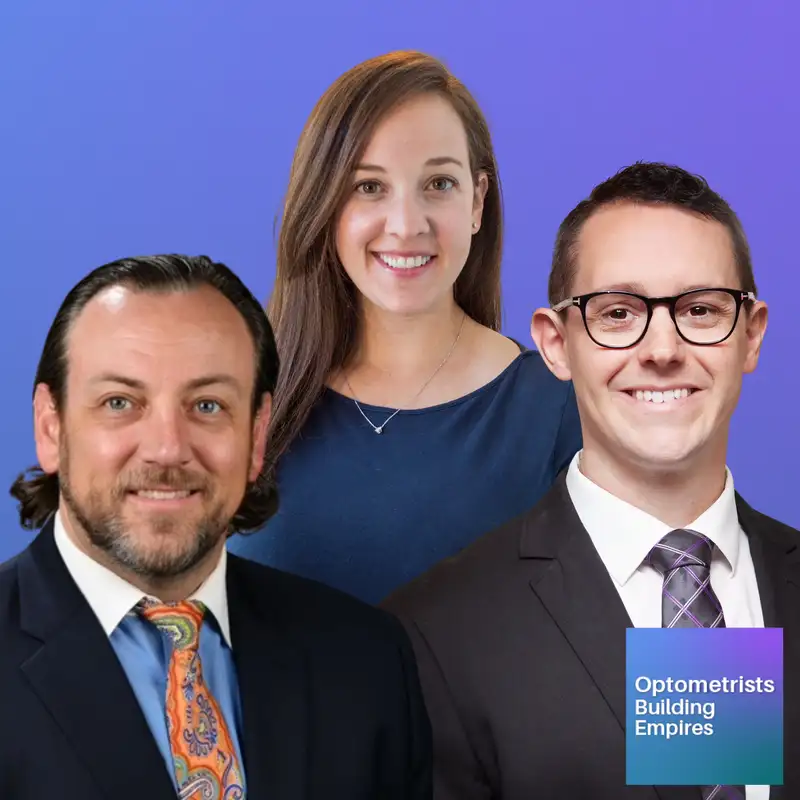
Ankit: Today's episode is a special one. We have a, a special panel with [00:01:00] us today featuring three accomplished optometrists and entrepreneurs. And what makes this conversation especially unique is that all three guests have graduated together from Indiana University, in 2008, and each has gone to build on impressive careers and businesses within the industry. So I'm super excited to dig into their personal journeys and hear about the lessons they've learned and, you know, some hardships and, and what they've accomplished in their, in their careers. today joining us, we have Dr. Patrick Curran of Johnson Curran Optometry Centers, Dr. Jenny Cohn of Moses Eye Care, and Dr.,
uh, Andy Yarian of Yarian Eye Care Center. So welcome all.
I'm gonna ask this question one by one, and then we're gonna kind of take it as a panel discussion from here. But, uh, the first question is always: What was the most important thing that helped you grow your empire?
And, uh, Jenny, I'm gonna ask you to kick it off.
Jeni: That is a great question, and I can think of, you know, a million [00:02:00] things off the top of my head. But I think kind of the one thing that stands out the most is the structure that we put into place, uh, for our growth. so a little background. We have 12 locations. It's a family-owned practice. My dad, my brother, and I run it. and when I joined the practice, it was four locations. And, you know, they were kind of seeing all the offices part-time. And very quickly as we started adding locations every 18 months to two years, I couldn't do it all. There's just no way to see patients and do all the staff and the HR and everything that goes running with a business. we put in a structure that really allowed us to grow, and within that structure, and this is the other half of it, is the key leadership. you have to have the right people on the bus, and you also have to have them in the right seats. And if you can do that and have this growth potential with the structure, you can keep adding practices, and growing and adding doctors.
and it becomes pretty, I would like to say simple at that time, but that would be an understatement. [00:03:00] But it allows you that growth, which is pretty cool.
Ankit: I've definitely got a lot of questions there, which we're gonna dig into. Andy, what about you? What would you say your most important thing was to building your empire?
Andy: So when I came right out of school, I didn't have a huge support system. I kinda had to figure that out on my own. And so, you know, I came out a little bit of background about me, I came back to my hometown. I started working with a doctor who had one exam room in an 800 square foot office, and I kinda just followed in his footsteps initially.
And then a few years later, we built an office from the ground up, grew that, bought another or, uh, started another cold location, got another doctor started, then started a third location, got a couple other doctors started. So kinda went that direction. But to back up and to even make that initial step to get to that, to build the building, it was for me, it was mentorship. I needed some mentorship because I didn't have a lineage of family to help me out. I didn't have any brothers or sisters, nobody to help me. And so... And I gotta give a shout-out to, uh, Dr. [00:04:00] Cohen, uh, Dr. Jenny's brother, Rob, uh,
Jeni: Yeah
Andy: of the Moses family there. I really relied on him and Jenny.
That's the great thing about being classmates and we're all so close, and that's what makes this panel so interesting, is I really relied on him to give me some help. And then, uh, I also sought out some professional coaching, which I'm still part of today, which is helping me develop that framework, helping me to, uh, recruit, train, and retain team members and put the right people in place.
And so to piggyback off of Jenny's success and what she said is part of her success, I would agree 100%. It's getting that structure into place. And what I've learned, which we'll probably talk about later, is I found the greatest distraction to growing your practice is seeing patients. I mean, we all love to see patients and whatnot, but you gotta get out of the exam room.
And coaching and mentoring, uh, being mentored is, I think is a huge part of that success for me
Ankit: Yeah. What's the saying? Business, you know, the business would be easy if it wasn't for the patients and for their staff, right?
Jeni: Absolutely.
Ankit: that's-- that's-- I like that. [00:05:00] Uh, uh, Patrick, how about you? I'd love to hear your take on what you think your most important factor was
Patrick: Yeah. So I, think, you know, the baseline for growing an empire in optometry, number one, you know, you have to recognize the opportunity, and you have to know that with that opportunity, there's gonna be some risk along the way, so you have to be comfortable with, that. I think the other thing is that, you know, once you walk through that door, uh, and, and, and you, you know, capture that opportunity, uh, you do have to learn and understand the language of capitalism.
You have to understand different metrics, which I think, is a little different than maybe what you were taught at, in optometry school. And so I, I find, I, I found that, you know, as I went along, you know, my journey, just, you know, learning how, you know, capital flowed and, you know, how you measured, you know, suc- success, you know, that will help you, you know, get to those levels of, you know, the, the empire that you're searching for
Ankit: Yeah. I-- You know, I like it. So, so [00:06:00] I'm gonna sy- resynthesize what I heard back from you all. I heard, uh, a little bit of like who matters a lot, having systems and processes. but I heard the who part was not just the people working for you, but how you surround yourself with, with the people that are mentoring you. with, hey, you gotta know the what too, right? The financials and understanding the math i- is important. So kinda combining those three things will really help. So I, I'm curious, when you guys were growing your practices, and your, and your careers, you know, this is an interesting setup right here.
We had this panel discussion, right? Uh, you guys were... had a good relationship back in OD school. Um, did you guys leverage each other because you had that community? Did you guys talk to each other a lot? Did you help each other? Was it like a little support group? Like, how did, how did you make that transition from 2008 to now with, with the three of you all?
And I'll let, uh, Patrick, I'll let you start there and, and we'll kind of go around the table there.
Patrick: Yeah, absolutely. Again, I appreciate going first. I'm eager to hear what, uh, the [00:07:00] other panelists say. But I, I think the one thing about our class is I, I think we were extremely close. I think there was a, a subset of our 80-plus people who, went through the ups and downs of school and kinda had the same share- shared experiences.
So, you know, we, we kinda knew what we knew, and we didn't know what we didn't know. But then, you know, as you get out and you start venturing down your own career path, you know, you see, uh, through social media or, or, or other things online, you see other classmates be successful in their ventures and, you know, you kinda start sending texts or, or emails and then, you know, seeing which ways, uh, help you, you know, in your own journey
Jeni: Absolutely. And I, I think that I've never hesitated to call Andy up and say, "Hey, I've got this HR situation. What would you do? Uh, uh, help me out here." and I think he's kinda done the same, and, and we're lucky-- My brother graduated in 2006, so he hung out with all of us as well. [00:08:00] Uh, so we're all kind of in that same age range.
and you know, we, we all get involved in our state leadership as well. I know Andy comes to meetings and, and Patrick's part of VOA, I'm part of IOA, our state association. And so we go to these meetings, we sit down, we sit at the bar, we have a few drinks, and we talk business, we talk shop. Uh, and I think a lot of those in-person meetings and is, is been really helpful to help grow our practices 'cause we sit there and we talk about these things that are, are complicated and maybe, you know, ask questions and feedback.
And I'm also part of a study group called The Wise Guys that we've been part of for 25 years. And I think to Andy's point, when you have a group of people that you can have these honest conversations with about how do you deal with these tough things, what works in your practice, what doesn't, that is an exponential rate for growth, and it also gives you the sense of security of like, "Okay, maybe I'm d- I am doing this right.
Okay. That's all right."
Ankit: Yeah, I like that. A-and, and, uh, A-Andy, how about yourself? How'd you kind of work-- Like, how'd you keep relationships with your team? Uh, [00:09:00] obviously, Jen's, Jen's brother, uh, was helping you out, right? So yeah. W-what-- How else did the, did you guys support each other?
Andy: I think like she said excuse me, uh, you know, meeting with each other, keeping in touch with each other, social media like Pat had mentioned. I think too, to be honest, and I think we would all agree with this, we have a very friendly... I, I, we-- it hasn't been spoken about, but it's kind of an unspoken, and it's not so much that I wanna do better than anybody, but it's a friendly competition.
That's the way that I see it, and it's with myself mainly. You know, and I look at the success that Pat and Jen have had, and they've just grown exponentially and, you know, Jen's, Jen's four times the size that I am, her practice is, and, you know, Pat's three to four times the size and, you know, I'm catching up though, and I'm gaining traction and I'm, I'm getting there.
But it wasn't a competitive mindset, like I can do better than them. Again, it was an open mindset and I looked at them and it's like, wow, man, they're just killing it, doing an amazing job. I gotta know what's the secret sauce. Hey, tell me. And the great thing is about Pat and Jen, they're not secretive about that because they, they want, they [00:10:00] want me to succeed.
We want each other to succeed, we, we all wanna do really, really well and do what's best for our profession, of course. And we feel that that's obviously within the scope of private practice optometry, and that's not a dog or anything else on, you know, commercial pr- uh, practice. But I think that's it.
And I think, you know, meeting, like Jen had mentioned, we're in the same state, we, uh, you know, we have our state convention, we have a fall seminar, we all meet, we all sit down and talk, and it's like, you know, I, uh, again, I reach out to Rob and I reach out to Jen and even Pat. You know, Pat's been filling me in on the AI stuff, and it's like, I'm gonna do that.
I'm gonna get on, you know, Anthropic and Claude and start checking some of that out. It's time to introduce that. And then, you know, uh, Jen and, and her brother Rob helped me out a lot with insurance stuff and helped me out with like, "Hey, what are you guys doing this? How are you guys handling this? What's-- are you managing and leading all those offices and it not just being utter chaos?"
And so... And we feel really comfortable in going back to our schooling, you know, and, and, [00:11:00] and building those relationships and that bond in school. Super comfortable to send texts, and I don't think there's any kind of offensive questions or anything that anybody's gonna be like, "Ugh, you shouldn't ask that.
That's off limits." I don't feel that way, and I hope they don't feel that way about me. So,
Jeni: No. And I, I, to, to Andy's point, and I think this is important for anyone listening, if you can have that core group of people that you can have those honest conversations with and that they challenge your ideas, they don't just still go, "Oh, okay, great." Like, I guarantee anything I say, these two are probably gonna point out all the weaknesses and make me defend it, and I love that because that makes me stronger, it makes me better, and it finds these holes that I'm like, "You know what?
I didn't think of that. Let me fix that." It makes you more successful
Ankit: I, I, you know, just as a sort of a lesson, just as a, a third-party perspective, sounds like if, if I was going through OD school right now, I think that there is a point of emphasis to say like, "Hey, your, your folks that you're going to school with, developing those relationships can be lifelong career personal relationships that you can take and help you beyond just school."
I know that sometimes we might have the attitude like, "I just [00:12:00] wanna get in, get out, just study," but that connection is really important 'cause e-every one of you to a T is like, "Oh yeah, the relationships make a difference. The people make a difference."
Patrick: I do think it's easier to have those difficult or challenging conversations when there's a level of trust. So I think just because we came through schooling together, you know, we would be more trustful of those people in the class of 2008 or around our class, you know, as opposed to, you know, a different school or something like that.
Not to say that, you know, we don't trust our colleagues, but, you know, we've kinda gone through the battles together. And so that's where it's a little bit easier to have those discussions on, you know, empire building or, you know, anything else that we're looking for
Ankit: when they say you had to spend like 400 hours with someone to really get a really good relationship, so I'm pretty sure you all spent more than that in OD school together
Jeni: I, yeah, I think
Patrick: Ab- absolutely.
Jeni: 400 mark for sure.
Patrick: Yeah, absolutely
Ankit: so I'm gonna ask you a slightly different question. as you guys are growing your businesses, your locations, your quote unquote empires, what did you [00:13:00] run into that you didn't expect? Like, it was like, "Oh, wow, that was a real surprise to me." Uh, Andy, I'll let you kick this one off
Andy: Yeah. I think the biggest thing is leading people and even patients, interacting with patients and how to handle complaints, how to handle pushback. But then, think, I think there's that human capital side. It's like, you know, you're, you're the leader, and you're the one that's gotta set the example, and you gotta set the tone, and you gotta set the vision, and you gotta be able to set the goals and which direction you wanna go.
So I think goal setting is obviously important too, knowing which direction you wanna go. But then to try to get everybody to move in the same direction is, is, is a challenge. again, going back to coaching, that's really helped me out, uh, with that. But I think we all have a great work ethic. I don't think any of us are afraid to see whatever amount of patients in whatever amount of time is necessary to generate the revenue.
That's, that's, that's the given, right? That's what you're taught at optometry school is to see patients and diagnose and treat and do those things. But, the biggest surprise was that I think the, the, the financial aspect that Matt's or Pat's [00:14:00] mentioned is P&Ls, the balance sheets, the cash flow statements and stuff.
You gotta, you gotta learn that. You gotta learn inventory management. You gotta learn where your metrics are at so you're not, you know, working your you know what off, and then at the end of the month you look and it's like, "Boy, I really killed it and I don't have any money. It's where did it all go?" You know?
And you gotta, you gotta be able to manage that. I think the biggest thing again is, is probably that leadership aspect and really, really getting everybody to move in the right direction
Ankit: Patrick, how about you? What was something you d- ran into that you didn't expect that was surprising?
Patrick: Yeah. So I think, you know, initially, you know, coming out of school, your main focus is, is the outward patient care. And so you adjust from the academic setting to more of the real-world setting where, you know, maybe you're dealing with more third-party payers and you're trying to learn how that system works.
I think as you develop through, you know, that's, that's one, point where, you know, you have to kinda learn. The second point, you know, when you're g- growing your business is, you know, the, admin or the [00:15:00] operations side and just kinda looking at what's going on behind the scenes and, you know, making sure those things are taken care of, which is, you know, completely different than the outward patient-facing aspect of your practice and trying to balance that.
And then, you know, the third thing is that, you know, nobody's operating in a vacu so you have outward market pressures as well. I, I think at least when, you know, Jenny and Andy and I came out, we came out right when, uh, the financial crisis hit. And so, you know, we've kinda seen some inflationary pressures on the business side, as we've gone through.
And then obviously with COVID in 2020, I think that's kind of exacerbated a little bit more. So, you know, looking at everything and, you know, when Andy says looking at the metrics saying, "Okay, are those inflation-adjusted? Are they real?" And then saying, "Okay, you know, am I gonna have short-term success, long-term success?"
And then how do you map that, that out? So I think, you know, maybe some, um... I was a little naive coming out of school saying, "Oh, you know, once [00:16:00] I get out of school, you know, everything's gonna be rosy." Uh, but then you kinda learn, okay, you know, we've, we've got these patient care issues, then you have these business issues, then you have these market issues.
But I think, you know, that, that can only make you stronger
Ankit: I love this perspective. I, I like how you're, you're building on that of, of... Yeah, I think it's a good call-out because even optometry's not, uh, immune to market pressures like COVID or the, the crash of tw- 2008, 2009. was a rough time too. I remember that. Uh, Jen- Jen, how about you?
What, what was something that, like, hey, you got, you got hit in the mouth and like, "Oh man, that was tough"?
Jeni: honestly, I, I think that running a practice and, and having the growth has been holding up a mirror to myself, and I think this journey of self-discovery was something I didn't expect. I am the type of person that if you work hard enough, you'll be able to achieve it. I think a lot of us in optometry school that become doctors are the same way. I'll just, I'll just work harder. It'll be fine. I'll get it. I'll get it. There comes a point where that doesn't work. There aren't enough [00:17:00] hours in the day, have to be able to delegate. You can't micromanage. You, you have to be able to step back and do all the admin things that these two have been talking about. and I think that I, I definitely had a, a lot of self-discovery and, and running a practice was holding up that mirror because I don't, I don't necessarily didn't love some of the things I saw, and I had to change it, and it was really hard to do. It was really hard to do. So I wasn't expecting that as a coming out of school and being a business owner.
Ankit: so let's shift to, uh, Patrick, the one person who had nothing wrong with his personal view on the world. And, uh, I'm, I'm just kidding. You know, I'm just teasing you, Patrick. but, but I, I like your appro- I wanna touch on, uh, so Andy, you talked a lot about, like, coaching. Jen, you just talked about, like, hey, this was a lot harder than I thought. Patrick, uh, I, I like your perspective on the market forces and financials too, so I wanna touch on that a little bit too. uh, you know, on this podcast we've heard a lot about the individual journey. What was a s- surprising thing from, from, uh, like, let's get specific. Like, [00:18:00] specifically, what about the market was different?
What made it difficult with the optometry business? was it not getting enough patients? Was it not converting, managing the cogs, managing staff? Like, specifically the, on the financial side or the management side, what specifically did you see as challenges through the ups and downs through the years?
Patrick: Yeah. Yeah. So and, and again, this is just my personal opinion. I think, you know, when we come out of optometry school, we are very well-trained for the operations of optometry. I think, you know, you're a provider, you know, you get your license, you have all this knowledge base, and, you know, you can serve the patient very well to help them with visual clarity, you know, and glasses, contacts, you know, co-management of, of surgery.
You know, those are all wheelhouse things. And I think, you know, as an associate, I think, you know, that can be appropriate. I think, you know, going back to the title of the show and, you know, building empires, you know, just kinda crashing through that wall, you kinda learn that there are other forces [00:19:00] out there.
You know, I think, you know, healthcare, is in demand, in, you know, my state and the nation overall over the globe. You know, I think there's a discussion about how you deliver that to the best of our abilities, both micro and m- and mac- macro. and, and, and I think, you know, there are times where, you know, uh, providing patient care and running your, your business may have different in- incentives.
And I think as the provider, you always have to make sure that you take care of that patient. and I think if you do that properly, uh, it can be done, done well. stepping outside of the patient care aspect, you know, I think, you know, provider reim- reimbursements, I think, you know, those are things that are, are always a topic of con- conversation.
I think, you know, young associates', expectations and just trying to learn, you know, how they fit in the market as well, which is something that, you know, I went through, you know, when I first [00:20:00] came out of school. But just kinda having those conversations, having that communication, and then having both, you know, small picture of where your practice stands, but also the big picture of, you know, inflation compounding higher prices and, you know, how does that serve you as you go through, your quarterly numbers, annual numbers, you know, and just see where the trends are in your practice.
Ankit: I'm curious. So this is something that I don't think that's been explicit, but I've kinda-- this is how I kinda viewed optometry from an outside perspective. There's sort of different modalities that everyone can practice. there's, there's the modality that, hey, you're effectively access to care, like rural shops, Medicare, Medicaid, usually Medicare pra- heavy practices. Uh, but then there's the boutique, like, hey, we're more luxury retail or we're more elective procedures, heavy dry eye, maybe myopia. So there's different ways you can practice. Patrick, you use a lot of language around access to care. Andy, Jen, is that similar how your practice is run? Are they more [00:21:00] access to care?
Are they more boutique? A little bit more of a blend. How do you-- What's your business model there and how is it run? And what are you seeing that Patrick is talking about? Can you build on what he's saying, uh, in terms of like the financials
Jeni: yeah. So for us, we, uh, we're your definite acts of care. We-- access to care. We have, we accept, accept almost all insurances, including Medicare and Medicaid. We're a heavy Medicaid practice in multiple of our locations. my dad was born and raised in Gary, so we have two offices in the Gary area, uh, which is high Medicare, Medicaid almost exclusively.
so we have learned to navigate that. But I think what Pat said is, you know, we're not trained for that. That's one of those surprises that you get out of school. and it's highly influenced by the market. we're great to have-- uh, we're very lucky to have a great system here in Indiana for Medicaid.
Uh, but my dad was a third-party chair of Medicaid for 35 years, so we know how to navigate. We know how to use those programs. We know how to make sure that we get reimbursed because I think that's the other part of it too. Like coming out of school, I, I didn't know to read an EOP. I didn't know [00:22:00] to look and say we didn't get paid.
Oh, my staff's writing that off. Why, why, why are you writing that off? Are you kidding me? We need to fight those claims. But if you're not looking and not paying attention to it, that's huge. you know, the outside forces like the insurance companies, they're down-coding you. And if your staff doesn't tell you, if you're not looking at it, you're not getting paid.
and that is so influential to your bottom line so that you can do things like hire and s- and have staffing and, you know, give them increase in wages. And I, I-- from your original question, I think hiring is, is my biggest, market influence. Uh, making sure that we're keeping up with, you know, cost of living, that the other market share around us, what other people are hiring in at.
It's caused us to, to raise and kind of go back and forth. and that's been an ongoing thing for, for years now. So and, and I found that to be a huge challenge personally.
Ankit: I appreciate the insight. And Andy, how about you? What, what are your perspective on this?
Andy: Yeah. You know, again, for us, we're, we're in small communities, you know, rural Indiana, uh, w- definitely access to care. [00:23:00] So kinda similar to Jin's practice, you know, we have Medicare, Medicaid, and then we have commercial payers and whatnot. But yeah, you know, to the best of my knowledge, a- and I, I keep up with it, you know, and I look at it every single week or month, but as far as reimbursement rates from insurance companies have not kept up with inflationary pressures. They, they have not. And so then you have to create that margin elsewhere, when you're capped from insurance reimbursement rates in order to be able to, you know, pay your team members more, and you have to be able to retain them, right? I mean, you can't, you can't just look at your team and be like, "Okay, well, we're gonna hire you at this, and then we're just gonna keep you there and maybe give you a 2% or 3% raise every year regardless of your performance and the, you know, your results."
It's like you can't do that, and we try to focus on our practice about results-based compensation. Yes, you have to pay a competitive hourly rate. gonna have to figure that out. And so what we've done this year in our practice is we said, "Okay, can we generate more revenue and get more money to fall to the bottom line?"
Yes, we're gonna look at maximizing reimbursement rates and make sure we don't get down-coded and we're not writing things off, and we're chasing [00:24:00] after the, the, you know, the denied claims. But, you know, we're bringing in, uh, a vision membership plan where we've realized that just in the first... We launched it April 1st, and at the end of this month, we've had 72 people sign up that pay out of pocket that I really didn't realize that we had.
I figured we'd get maybe 10, 12 a month. Well, we- now we've gotten 72. And then we're bringing in IPL, you know, and you think, oh my gosh, you know, you're-- I'm in one of the poorest counties in Indiana, but I also, you know, did a little bit of research. We committed to buying it, and we kinda did a very loose survey like, "Hey, would you pay for a product, you know, that would relieve this?"
And go through that whole process, and we found out we had more people say yes. And so then we committed to buying the, you know, the IPL and, uh, you know, we're doing that. And so we're trying to figure out ways even outside of insurance to maximize reimbursement, you know, retain those patients and still have, you know, revenue and margin left over to, to operate the business and retain our team members [00:25:00] by, by increasing compensation.
So
Ankit: what are the current struggles? I know a lot of people-- we, we kinda touched on it, staff, Uh, you, you guys kinda touched on how you're dealing with it. How, how would you suggest to someone who might be struggling it now based off of what you've experienced, how to deal with either staff challenges or reimbursement challenges or both?
and so you guys kinda hinted at a little bit about like wage payments, about right seat, right bus,
Andy: you know, throughout the course of my career, I, I mean, I try to focus on, you know, staff retention and whatnot, but what we started becoming really intentional about in the last two years is getting in front of our staff every ninety days. You know, so I have a group of team leaders, and I have, I have four team leaders and an administrative assistant, so maybe five. And, we-- every ninety days, we get in front of the team, and we, we flat out ask them. We tell them where you're doing well, where you guys need improvement, and then what can we do to improve. Tell us, are you happy with your compensation? Are you happy with the hours? Are you happy with the culture? Are you happy with all of those things? [00:26:00] y-you know, we, we try to get out ahead of it in order to make sure that, you know, we are keeping those people. And because, I mean, we're-- we wanna invest, and we wanna train those people, and it makes it really tough if you go, you put a significant amount of time and money into these people, and then they, you know, a few months later like, "Hey, I'm leaving."
And then it's like you feel like you gotta start back over at square one 'cause you gotta hire somebody and then train them back up. And then if you don't, you're not able to, to, you know, retain them, uh, that, that could be a really, really big challenge and kinda thwarts some of your, uh, some of your expansion.
And so it-- that for us has been the biggest, I think, challenge that we feel like we've headed off. We noticed that our turnover rate has now dropped significantly in the last year and a half. and, y-you know, money is important, and I'm not, I'm not shy about that. I talk about that with my team, and I try to create as much opportunity as I can with them. "Hey, you help the top line go up, you're gonna get a little bigger piece of this pie, okay? That's, that's where it's gonna come from. And so you-- and here's how you can do it." And then we sit down and [00:27:00] specifically go over, you know, points about how you can generate, help generate more revenue
Ankit: Jen, how about you? Uh, staffing, you can choose staffing challenges, you can choose reimbursements, several. You kind of talked about both.
Jeni: Yeah. I'm gonna, I'm gonna-- staffing is a, is a big one, and I'm gonna kind of play off Andy's comment here because I think it's, it's culture and confidence. So you have to have the right leadership that has the right culture. If you're not setting the right culture in your office, I don't care what you pay them, gonna be a toxic environment and they're gonna leave. It's, it- period. And, and we've, we've seen that kind of happen. my husband always says addition by subtraction. So if you've got that one bad apple and you get 'em out there, all of a sudden, without even hiring, everything's doing better, everything's running better. So, uh, the office culture I think is huge and you, and you've gotta set that intentionally and you have to have leadership that exemplifies that for sure, and holds the staff accountable to it.
The other is confidence. We have an extensive training procedure in each of our departments. so you know, we have benchmarks. Everybody goes through these exact benchmarks. They have to sign on them. The trainer [00:28:00] has to sign on them. The team leader has- we have team leads as well. Team leader has to sign off on them. and, and there's expectation because I never wanna walk up to a staff member and they say, "Well, I didn't know how to do it." You, you did because here's your training and here's your signature. So there's accountability to that too. But when you hold them and you have these benchmarks and you have them trained properly and you put the time into training, they have more confidence and they take ownership of that position and that reflects not only in their care that they're giving to patients, but again, the culture.
so I think that's really important and I think those are things that we've invested in over the years that have allowed us this continued growth that we've seen.
Andy: I think one thing to comment on that, I think absolutely, Jen, I think that A players will not stick around with C players. They will not. And so we've, we've learned that, and I think your level of success will be dependent upon the, the direct level of difficulty of conversation that you're willing to have.
Sometimes you have to cut people, just like you said, you get addition by subtraction, and you gotta protect the A players
Ankit: so question for you [00:29:00] all.
So A-Andy, Jen, you guys are talking about the culture, how it's so important. play devil's advocate. I'm a doctor. I'm not really a doctor, but I'll play one in this scenario. so I'm a doctor. I'm like, "You know what? I'm seeing patients all day. God dang it, I don't wanna deal with this. Like, it's just one small thing.
What if I just let it slide? I just don't wanna hire someone, train someone, go through it all again. I don't have the time or energy to do that, so I'm just gonna let that go," right? So, so Patrick, h-how have you dealt with that kind of friction? I mean, have you ever been in that spot where you're like, "Ah, I just don't wanna get rid of it 'cause it's just easier to keep them"? how, how do you work through that psychology? And, and Patrick, like I said, you can phone a friend too if you want to, to get help with this if you haven't dealt with that.
Patrick: Yeah. Yeah. So I think, you know, you have to have standards in your clinic. You have to have standards in your practice. And I think if it's important to the leader, you know, it has to be important to the associate. I think my way of handling conflict points is much different now than it was a decade ago, and it's just because I've done it more and I've, you know, I, I have some [00:30:00] experience with, with that.
you know, there have been times where, you know, I've dealt with, uh, you know, maybe an issue and I, I, I could have done it better. So, you know, you try to learn from those experiences the next time something comes up. I don't think that, conflict will ever go away, but I think if you address it, uh, in, uh, in a more quicker, uh, or, you know, in a efficient manner with proper communication, I think you can get through reasonable stuff.
I, I think kinda my demarcation is, you know, is this reasonable, uh, or is this unreasonable? And then if it's unreasonable, then you kinda put it in a bucket and say, okay, you know, there are rules that, you know, the optometrists have to, you know, stand by, whether it's your state or, you know, your, your region.
and again, you have to be, conscious of what those rules are because, you know, one of the things, again, I'm in Vir- Virginia, you know, I, I kinda break Virginia up. You have Northern [00:31:00] Virginia, you have Richmond, you have the beach, uh, Virginia Beach, and then you have everything else. And so, you know, we're, we're kind of in everything else, but, you know, there are really good things about our region.
But the rules in the state of Virginia that apply to Northern Virginia apply to everything else also. So you have to be, you know, conscious of that specifically when you're dealing with, an associate optometrist.
Jeni: Yeah, I, I think when you're in those tough situations and, and you have somebody that doesn't wanna deal with conflict... 'Cause let's be real, the majority of optometrists don't wanna deal with conflict, and so they just turn the blind eye and they let it go. And I get it. It's instant gratification.
You don't have the time to deal with it right now. But my concept is you're either gonna pay now and have that instant gratification to have something smaller, or you're gonna pay later, and odds are when you pay later, it's gonna be a much bigger cost. So addressing those issues when they come up, when they're smaller, are much easier to manage than when they've compounded and they've snowballed, and potentially, like Andy indicated earlier, you've lost some good people or you've damaged that [00:32:00] culture.
So I know putting it off, nobody wants to do that, or everybody wants to do that, but it's, it's gonna get you. Pay now or pay later
Ankit: So Andy, I'm gonna ask you, uh, to build on that a little bit, but specifically since you've got a lot of extra, uh, coaching and outside help,
Andy: Mm-hmm.
Ankit: has the coaching helped you kinda, kinda help with that tr- that, that able to have this harder conversation? If it has, maybe I'm making that assumption
Andy: Yeah. No, it has for sure. And so what you, what you do is, uh, I, I, I think I-- we all agree we can't be everywhere at one ti- one time. We all have multiple locations, and we don't specifically know what's going on in other locations or at, at any given time. You know, there-- I'm not in the office all five days a week, but I've coached my team leaders, and I meet with them weekly.
I meet with them an hour every week. We have an agenda that we go through, and we do these things, and I use it as a coaching time. And then we do off-site retreats, uh, you know, roughly every 90 days, sometimes 120. But then we, we use that as a coaching session for the team leaders, and then they are essentially [00:33:00] representative of me, okay? And so I try to delegate to them certain, certain things, right? Like we don't, we don't write anybody off. I mean, yes, we document for sure. But, you know, I use the analogy of if you were doing 55 in a 35 and you're driving and a police officer pulls you over and he gives you a ticket, the officer's correct.
You were speeding. But do you drive away from that thinking like, "Oh my gosh, I'm so glad he gave me a ticket. He's right and I was wrong"? You know, and I might get some pushback from that from some team members, but I found that, there are conversations that you have to have and you have to document, but I use them as coaching sessions either with, uh, team leaders or with those team members, but addressing it right then and there.
Do not drag out. If you hear there's a problem going on and your team leaders can't solve it or they don't know how or they just need some clarity or direction, you've gotta almost what you're doing, that immediately. And you don't wanna, you don't wanna act off of, you [00:34:00] know, being very sporadic.
You're very, you know, just really quick, irrational decision. But, you know, by now we've done it long enough that we kinda know the scenario. There's really not a whole lot that we've had in our practices that we, we haven't addressed before. I mean, and so you gotta address that right then and there. You know, we had a, we had a, a, a situation a couple of weeks ago where there was an issue with a team member that had been here for almost two years, and she was doing a really nice job, but there was just something she said and did.
It's like, "That's unforgivable. You gotta go." You know, we gotta-- And we let her go that day, you know. And, and it, it's tough. It's really hard because she has a family and she has kids and she has all these things, but she knows the standards. And if you, if you let that go below the standard, the rest of the team members are gonna see that, and they're gonna think the same thing.
They're like, "Well, if she got away with it, I can too." No.
Jeni: can we go back to a question here? I- it's, you don't do write-ups? What?
Andy: I do documentation, and I do let them know that if it's a behavior that's unacceptable, I say, "Hey, listen, this is not what we want. We wanna-- We want you to go this direction." We try to coach them on that, and we do let them know, like, "Listen, if this [00:35:00] continues, your job is in jeopardy, okay? We just wanna be up-upfront with that." you know, and we'll document it. You can call it a write-up if you want.
Jeni: Okay
Andy: but I try to not be... It, it's more I document this, okay? And, and we'll fill it out that way.
But I am, yeah
Ankit: the branding that you got there. It's not a write-up, it's just documentation with a warning you might lose your job.
Jeni: no.
Andy: It's
Jeni: No, we don't do that.
Andy: Yeah I like that a lot. I'm using that one. I'm stealing that one.
You
Ankit: One thing I, I, I've heard that I've really taken to heart is like, "Hey, what you tolerate, you endorse."
and that's-- it's really... I mean, I have to take my own lessons sometimes, but it's, it's, think, uh, below the floor activity is what we call it.
It's like there's just some stuff like I'm just like, "We're not gonna deal with it, guys." Like, "Hey, if you're not able to be proactive, it's just not gonna work here. If you're not able to learn a little bit on your own and just try to be proactive, try to come up front, it's not a good fit,"
Andy: We have a saying that says, "If you're not addressing it, you're blessing it."
Jeni: There you go
Ankit: hear., so between the three of you all, what is the most memorable experience from OD school that was really [00:36:00] formative for you?
That you I don't think I can share those.
okay? G-rated version, ladies and gentlemen. G-rated version
Andy: I will say we were an incredibly social, uh, class, if you wanna say that. We went out a lot, and that's what made us, I think, bonded us a whole bunch.
You know, I have a roommate, we'll say his first name, Zach. And, uh, Zach's a practicing optometrist in Indiana and doing great for himself. But we had a, uh, an apartment that was right downtown in Bloomington, and, uh, it was on the square really close to it. And we would have people kinda come and go because we were, you know, a walking path between the bars and then going back to where the school was, where a lot of people lived.
And so we'd have people stop in, we'd have get-togethers, and so it was a really good time. And of course, I think the AOA National Convention was in Las Vegas in summer of 2006, I think.
Jeni: don't think it's been there since. Let's just put that out there
Andy: So what will the, the saying about
Patrick: I was there
Andy: in Vegas stays in Las Vegas, we'll, we'll stop with that. You can...
Whatever you're [00:37:00] thinking, whatever imagination that you have, that, yeah, that
Jeni: the thing I love too is that it hasn't just stopped at optometry school. It's not like living, you know, living the heydays.
we still do a trip every year where we go to Michigan, and there's about, what?
15 to 20 of us that get invited, and now it's our families. the kids, they go skiing. So it's this trip we've been doing for 20 years since we graduated. and we always get together when we're at AOA or the state convention. I mean, I saw Pat in DC just a couple months ago. so it's, it's not just these one-time things.
It's, it's, the story's still being written, which is pretty great
Patrick: One thing I will say is that we had another friend who was in a band back in optometry school, and that, that was a lot of fun. But, recently, I must say Indiana is the only optometry school that can lay claim to having both an undefeated national championship basketball team and undefeated national championship football team.
[00:38:00] And, our friend who was the drummer in the band, uh, Andrew, me and him went to the game and saw a whole bunch of, classmates and people we knew from school. So it was really neat just to experience that 20 years later, you know, kind of in your middle age, uh, years and, uh, you know, still have, as Jen said, the memories keep on going
Ankit: I love it. That's great. I, I love how you guys are such a close, uh, group. I think that's really seemed like it's helped you all out a lot since then too. Uh, so if people want to reach out to you all, where can they find you?
Patrick: Sure, sure. again, uh, johnsoncurran.com is our website. Uh, again, I'm on LinkedIn at Patrick Curran OD. again, I, uh, travel to a lot of the meetings. I'll be going to AOA in June.
Jeni: Same thing on LinkedIn, Facebook, all those kinds of things. The, the old millennial site there. I'm heavily involved in the state level and the national level, so you can always come up to me at conventions. I welcome conversation. I love it. I think it's great. I'm happy to give my [00:39:00] email if you'd like to do that.
uh, uh, reach out at any time. I have no problems, uh, engaging in conversation. I, I, I think you can tell that we all just love to talk shop
Andy: same, same thing. You know, the basic, you know, email yarianeyecarecenter.com and then you'll LinkedIn and then, uh, Instagram too, just andy.yarian. That's my personal account. But any way you can get a hold of me, I'm just a, I'm just a guy. I'm just Andy. You know, I'm, I'm, I'm Dr. Yarian, I guess, between these four walls, but outside of this, in my little community, I'm just Andy.
And so, uh, I, I love going down and talking to the private practice schools and, uh, the, uh, or private practice optometry.
Patrick: I think one other thing that, you know, we all enjoy is that, if there are younger graduates or, you know, people who are in their first decade of practice and, you know, they're trying to build something, you know, if they do see us at any of these meetings or wanna send us a message, uh, we'll be, we'll be happy to help.
So
Jeni: Always
Ankit: I wanna say thank you all, Andy, Jen, Patrick, again for being on the show. It's [00:40:00] been great having you as guests
And I wanna share one ta- one takeaway that I kind of synthesized. Uh, you know, obviously know your books, get some help, spot the people, but relationships really seem to matter, right?
Like, I think, Patrick, I reached out to you, but you were like, "Hey, let me get my other friends on here." Like, you're the one that suggested this, so I really appreciate that. So I think that relationships are really the foundation of everything that, that's made you all successful, if I'm gonna reflect back what I'm seeing. and, and, and so thank you for sharing all that. And then thank you, audience. If you learned anything or laughed, please share the podcast with some friends. Uh, and if you make sure to subscribe so you never miss an episode, and if you book a meeting on the, uh, meeting link, I'll send you a free copy of my book, Optometry Redefined.
Uh, thank you all for being guests on the show, and this has been another exciting episode of Optometrists Building Empires. We'll see you next time
That's a wrap on another episode of Optometrists Building Empires. Thanks for joining. For show notes and more, visit buildingempires.live. This show is proudly sponsored by My Business Care Team. My Business Care Team was born out of [00:41:00] staffing challenges my wife and I faced together managing multiple optometry locations.
We refined our approach at Classic Vision Care and now offer our expertise to others. If you're experiencing challenges with staffing and you'd like to set up a discovery call, we'd be happy to help you and connect you with the right resources. We'll see you next time.
Creators and Guests